Wednesday, 9 November 2011

Paris continued

Montemarte Museum
We wandered up to Montmarte just for fun as we had been there before but it is an interesting area anyway. We found the Montmartre Museum which proved worthwhile. The building which houses the museum is a charming white house, the finest in the area from 1875 provided studio space for many artists including Maurice Utrillo, Raoul Dufy and Renoir. The museum recounts the history of Montmartre through artifacts, documents, photographs and drawings. It has some wonderful displays relating to Bohemian life that flourish round the area.

From the museum you can see the cabaret-restaurant Au Lapin Agile which in 1900 was popular with artists Picasso and Renoir and poets. It got its name from the humorous painting by André Gill which was a play on words. Afterwards we wandered down the hill and managed to get a bit lost among the tangle of streets but eventually hit a metro station and were once again on track. Then we went to explore the English language bookshop ‘Shakespeare &Company’ the best bookshop in Paris is historic and rather ramshackled but is packed with books both new and secondhand. You could lose a day in there just browsing.

A walk from our hotel the length of the Rue de Rivoli was very enjoyable.

We treated ourselves to a really nice meal at the restaurant Auberge de la Reine Blanche on the Ile St Louis. Another nice restaurant close to where we were staying on the Rue du Roi-de-Sicile is Feria Café on Rue du Bourg Tibourg.

Reims

A day trip to Reims is easy to achieve especially if you take the magnificent TGV trains, more expensive but quick.

Reims Cathedral
Reims is in the Champagne region and it is possible to visit some of the vineyards, but as we just planned a day excursion we confined ourselves to the town. The reason for the trip was to visit the magnificent Gothic cathedral there. The Cathédrale Notre Dame has been the home of the coronation of most French monarchs since Clovis was baptized there in 496. The building of the church was begun in 1211; it has magnificent Gothic decoration that includes thousands of well preserved figures on the portals. There are many wonderful stained glass windows which adorn the church and those in the axial chapel were designed by Chagall. It is definitely worth a visit.

Next door is the Palais de Tau named after its T-shaped layout. At the end of the 15th century the palace was refurbished and then in the late 17th century. It was mainly used as  the archbishop’s palace. Here are housed the treasury of the coronations and the cathedral tapestries as well as statues from the cathedral which have been damaged during shelling in the First World War.

There are also some interesting museums in the town but a lot of them close for around two hours at lunchtime.

We wandered around the town and indulged in a glass of champagne a must really.

It is important to book your seat on the TGV and especially for the return journey. It is best to do it when you arrive at Reims to make sure you get the time you want.

The last full day we had in Paris we wandered along the Rue de Rivoli we started from near our hotel in the Marais area and came across a little farmers market situated in a small square straight away. Cheese was obviously well represented and a selection of fruit and vegetables as well as meet and fish.

We came across the church of Saint Eustache which was erected from 1532 to 1640; the long construction period was due to religious wars and lack of funds. The site of the church has always been a meeting place for the nobility, middle class, tradesmen and the workmen of Paris. Many major events and personages in French history have involved the church.

Saint Eustache Church
During our visit a high mass was in progress the beautiful refrain from the choir backed by the organ filled the church which enhanced a spiritual atmosphere.

When the market ‘Les Halles’ which was near St. Eustache moved in 1969 the life of the neighbourhood changed, a cultural centre was built on the market site put the church in a prominent position.

Continuing down the Rue de Rivoli we passed the Louvre and many interesting shops as well as the ubiquitous souvenir shops which sell the same things mainly Eiffel Towers in every conceivable guise and the other curse of all souvenir shops the ‘fridge magnet’

We discovered two English language bookshops and of course indulged and bought books. We are totally seduced by any bookshop and it’s hard to come out empty handed.

La Madeleine
Lunch at a little sandwich shop, further wandering took us to La Madeleine it is a Catholic Church which is designed like a Greek temple in 1764, it is one of Paris’s most distinctive sights. It is surrounded by 52 Corinthian columns. The inside is richly decorated.

As a suitable conclusion to Parisian interlude on our last night we went back to the Feria Café where we had our first meal.

The next day we left Paris for our long haul home.

Wednesday, 2 November 2011

Paris

Paris, the city of lights, romance and a million Eiffel Towers. 

I have been to Paris a number of times and lived there for 6 months in my youth so all the ‘big’ tourist attractions had well and truly been visited.

So this time it was good to visit the places not populated by hordes of tourists. Even since 2003 when we were there last the number of tourists has increased considerably.

We stayed at a small hotel in the Marais which was close to the Metro station St. Paul. This was quite centrally located and was in easy walking distance to most places.

Sainte Chapelle
I was surprised that I had never visited Sainte - Chapelle, which is not far fro Notre Dame. It was built in 1248 by Louis IX the future St. Louis to house the supposed Crown of Thorns and other holy relics. I t has 15 magnificent stained glass windows which are separated by 15metre columns which you follow up to a tar studded ceiling. The magnificent stained glass windows depict scenes from the Old and New Testament.

Close to Sainte-Chapelle is the Conciergie which was a prison in the 1400s. During the Revolution their 4000 prisoners held there, including Marie-Antoinette and Robespierre, before being guillotined. There are very good displays of prisoners’ cells and excellent presentation of its history as a prison and those held there. It still has the Gothic Hall of the Man-at-Arms, where the Royal Guards lived. The building still retains the 11th century torture chamber and 14th century clock tower.

We later visited a small museum of the artist Gustav Moreau a unique and compelling artist. An exhibition of many of his works was a feature at National Gallery of Victoria early this year. His work features Moreau’s obsessions with exotic subject matter, from classical mythology and the ancient world, to some of Christianity’s escapades and the poetic narratives of the Middle Ages. The museum is also his house and the top floor is devoted to his works and thee are a huge number. Much of his work has a Pre- Raphaelite feel to it.

Hotel de Ville
The next day we explored the Marais area taking in the Hotel de Ville, a rather ornate building which is the town hall, the official home of the Lord Mayor of Paris. It is only open by arrangement and for temporary exhibitions.

We then walked to the Place des Vosges which is a beautiful square, at the centre a garden surrounded by elegant buildings. It has been the scene for many historical events, which include a tournament to celebrate the marriage of Louis XIII to Anne of Austria in 1615; it was where literary hostess Mme. De Sévigné was born in 1626 and writer Victor Hugo lived for 16 years. He lived at No.6 where his house is now a museum which is very interesting.

Chateau Vincennes
Chateau Vincennes can be reached on the Metro the last stop on Line 1. It was establishes as a hunting lodge in the forest of Vincennes (long gone) by the Capetian monarchs in the 12 century. At the start of the Hundred Years War work on a keep was stated, then a protective wall with nine towers was built around the keep and manor was completed over decades. In 1380 work on the Holy Chapel was begun. Monarchs took refuge at the chateau during the 16th & 17th century during the troubles. Louis XIV only stayed there sporadically before he finally settled in Versailles in 1682.

The chateau has had some restoration over the years and there is comprehensive information in each area of the complex. It is all very interesting for anyone interested in history.

Monday, 10 October 2011

Vienna

We arrived here in the morning and easily negotiated the subway system to Stephandom. Our hotel the Marc Aurel was not far from there and easy to find. It is a good middle of the road hotel close to the centre of Vienna.

We wandered around re-acquainting ourselves with familiar places.  In the afternoon we went to the Albertina as they had an exhibition on Monet and beyond which was worthwhile. We visited the rooms of the palace this time which always prove interesting.

Ferris Wheel at the Prater

The following day we visited the Technical Museum which had some wonderful interactive displays.  Later in the day we went to the Prater which is a large garden area which was once a hunting ground for the aristocracy. It also has a fun park with the famous Ferris wheel hat was featured in the movie ‘The Third Man’.
When we arrived at the station we saw many people of all ages in the national costume, leather knickerbockers for men and the dirndl outfits for women, which ranged from long skirts to mini skirt versions, some girls even wore the leather shorts as hotpants. There was a wine/beer and music festival and it was fun to watch the various tents with music playing the more traditional music and the enthusiastic participation of the young.
The next day I decided to get out of the city and go to the Vienna Woods. It seemed that Mayerling would be an interesting jumping off point for this.  Mayerling is famous as the place where the crown prince and his 17 year old mistress committed suicide together. We arrived and what was there? Nothing!  A hotel and a chapel! No paths into the woods. We walked to the next town Alland and being Sunday nothing was open except a couple of restaurants. So we had lunch walked around the town which didn’t take long. We certainly didn’t want to miss the next bus out as they only came once every two hours.
At both Mayerling and Alland there was a map of the Vienna woods but no directions or signposts pointing to possible walks, so the day didn’t quite work out as planned.
The following day we enjoyed walking around the Hofburg area, then went to Karlskirke and back via the Burggarten. It was just nice to sit in the sun
After much discussion as to where we wanted to revisit, we decided on the Belvedere, it was good to do as we were able to appreciate more he paintings we had seen previously. You have more time to reflect on the works. We were surprised that even though it was our second time at the Belvedere we still spent the whole day there.
We revel in just wandering around Vienna looking at the vast range of beautiful buildings. We spent the day around the Rathaus area then we went back to the Vienna Opera House for a tour. It was very informative. Only a small amount of the original building remained after the war. The audience capacity is 1700 and the stage is the largest in Europe. The last treat for us was to have afternoon tea at the Sacher Hotel and have the original Sacher Torte. I must admit it was a bit too much of a chocolate and sugar overdose for me, but the surroundings were wonderful.
The one thing in Vienna I hate is all the ‘Mozart’ music touts you can count over 10 around Stephendom and various numbers around famous buildings. Even with head down and no eye contact you can’t avoid being pounced on, but I still love the place.
Now it’s an overnight train to Freiburg Germany.


Wednesday, 5 October 2011

The Netherlands- continued

Amsterdam
We had a smooth run from Den Haag to Amsterdam which took just under an hour. Our hotel Park Lane was easy to find and very pleasant. This time we were on the second floor, the first flight of stairs was OK, but the second flight was the ‘stairs of death’- very steep, shallow steps and a spiral near the bottom. These are typical of many Dutch buildings, the building is narrow, and the stairs are steep.
As this wasn’t our first visit to Amsterdam we took a more relaxed attitude to sightseeing. Our first day consisted of catching up with some friends for lunch and then spent the rest of the day with them. It was very pleasant and good to see them now they have a baby.
The following day we wandered around to familiarize ourselves with Amsterdam again. It attracts more tourists than Den Haag. The red light district and the cannabis cafes are more of a feature here. Again we caught up with our friends for lunch going across to north of the harbor which was a nice change of view.
Afterwards we took a short canal tour which was very interesting. Amsterdam is known as Venice of the north with its hundred canals and a thousand bridges. It was an extremely prosperous and important city in the 18th Century which went from nothing to nothing in about 100 years.
 For the first time since we left home it looked rain and it actually rained just as we got close to our hotel. The little café Smit & Voogt at the corner of our street turned out to be a great find and was definitely out of the tourist area as there was no English menu, the waiter was happy to translate for us.
Haarlam

Haarlem

The next day we left the city for Haarlem, the train conductor told us that the town is often used in films to depict Amsterdam. The market square is dominated by a magnificent church (aren’t they all). The construction of the present church was from 1370 to1538. There are many interesting features in the church, which incorporate the history of the town. A magnificent Christian Muller organ which consists of 5088 pipes and was almost 30 metres high was played by Handel and in 1766 by the 10 year old Mozart.

Leiden
Windmill at Leiden
We visited Leiden for the day, an old university town. It was unusual as it didn’t have the usual market square. There was a marked trail you can follow which takes in the various interesting points in the town.
The weather was perfect and as we wandered around we discovered the local market on the banks of the main canal. Here we had lunch sitting by the canal enjoying the passing parade of people soaking up the sun and atmosphere.
We visited the Franz Hals museum which was a small interesting gallery. Then off to the Leiden Museum which was both an art gallery and displayed information about the cloth manufacturing industry of the past.
Back in Amsterdam that evening we went to a wonderful small restaurant called ‘Marius’. The chef goes to the market everyday and chooses the freshest produce then cooks and 5 course market menu that night, so each day the meals will be different. The food was delicious and not heavy like so much of Dutch cooking .
On the last day we went to the Rembrant Haus. This house help bankrupt the artist as it cost him 130,000 guilders at the time and he had to borrow a great deal of money which eventually he was unable to pay back.
This museum had a range of paintings from various artists who worked in Rembrandt’s studio as well as some of Rembrandt’s work. The house and studio were set up as it would have been then and we had a demonstration as to how his etchings were done as well as information about the type of materials used.
We left Amsterdam that night for Vienna. 


Sunday, 2 October 2011

The Netherlands

The Hague
We arrived in Den Haag around 10 am from London via Rotterdam.  The first purchase was a map of the city, just so we could find our hotel. We seemed to take the long way round but finally arrived without too many detours. The hotel was small and simply presented. We were thankful they moved our room from the third floor to the first on our arrival as the spiral staircase was rather steep and carrying our cases up further than one floor would have sorely tested our stamina.
Peace Flame
We then went to explore the city. The Hague is one of the best kept secrets of tourism; it is a charming city that has much to offer. It is has its share of canals and 17th century classic Dutch buildings. It is the home of the Dutch Parliament, royal family and the international courts of justice Near the Justice Building is a perpetual flame for world peace which was sent from every continent this is surrounded by various stones from all the countries of the world, a very optimistic symbol.
We visited the Mauritshaus, a 17th century mansion which is now a museum full of old masters and includes some of Vermeer’s paintings of which one is Girl With a Pearl Earring. These smaller museums are often more satisfying than the large ones as you don’t become totally overwhelmed by the sheer quantity of paintings, You can spend more time really appreciating them.
Another interesting gallery is that of Prince Willem V which consists of a mass of paintings collected by him.
A typical view in The Hague
The Hague has the custom of high tea, even small cafes offer this. Two tier plates filled with cakes, pastries and sandwiches with a pot of tea. What a civilized way to while away an afternoon. There is definitely an air of wealth and refinement in this charming city
Delft
A day excursion to Delft was a 20 minute tram ride away. This was the centre of the Netherlands famous blue and white tiles and china. It is ironic that the blue and white ceramics from China inspired the original Delft ware and now all the cheap ‘Delft ware’ in tourist shops is imported from China. You can still buy Dutch produced Delft china but expect to pay a premium price.
In the centre of the town is the usual market square which is dominated by an imposing church called Nieuwe Kerk. A climb of over 350 steps to the top of the tower was worth for the spectacular view of the town.
Delft from church tower
As Vermeer lived in Delft it was only fitting they had a museum dedicated to him and his works. They had no original paintings only copies, however it was very interesting as it presented a lot of background about him and his works. There are only 37 paintings by Vermeer and three of those are disputed by experts. He wasn’t a prolific painter but as he had 16 children, that probably explains it.

Scheveningen
Kurhaus Hotel
A short tram ride takes you to vast beach area with a promenade along the shoreline which stretches from a fishing harbor at one end to grass covered dunes at the other. One glance along the shoreline you get the feeling that its Blackpool meets St. Kilda. There is a long pier which houses a casino and a bungee jumping platform. The only real refinement in the area is the Kurhaus Hotel with its 19th century elegance whose past guests included Winston Churchill and Igor Stravinsky. A ‘Who’s Who’ of entertainers have performed in the vast Kurzaal Room beneath the glittering chandeliers. We had to have a coffee in the café to suck in the elegance before we returned to the city.

Sunday, 25 September 2011

London - continued

Monday was taken up catching up with my cousin in Dagenham. Boy was it a long way out of London itself, by the time we left and headed back home it was early evening.
Regents Park
The next day we walked through Regents Park which still had beautiful roses in bloom and beds of colourful flowers even though it is autumn there. The park was started in 1812 and was designed by John Nash. There is a lake which attracts many water birds which also have breeding areas there .Queen Mary’s Garden was still a wonderful sight in autumn though must be spectacular in summer.
We then came to Regents canal, a tow path and followed that along to Little Venice, so called because a number of canal boats a moored along the banks. Many people actually live on the boats as they have a number plants, outdoor furniture and barbecues beside their craft on the land.

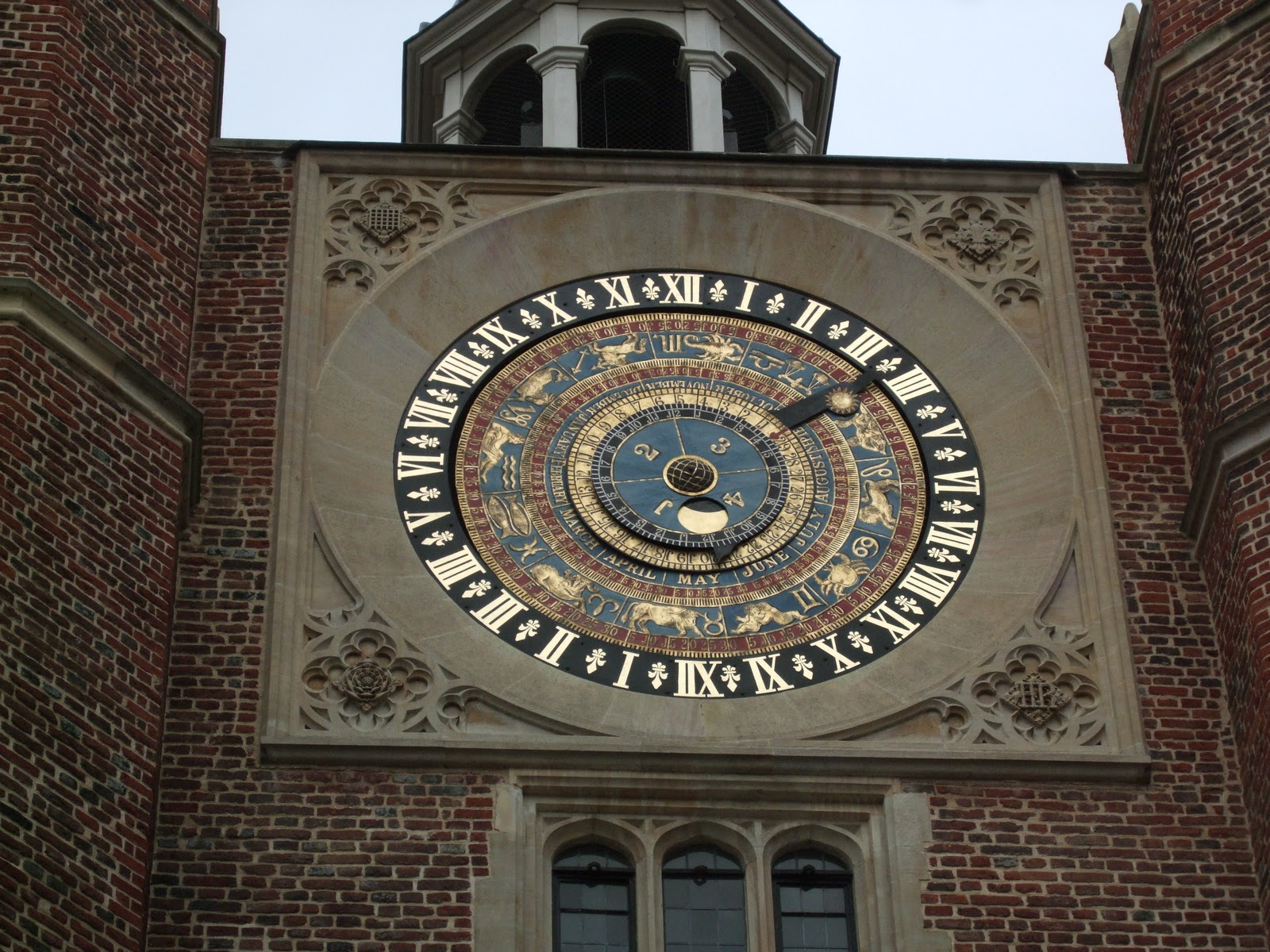
After lunch we decided to go out to Hampton Court. This was Cardinal Wolsey’s palace which was built in 1514 which was intended as his riverside home. He later offered it to King HenryVIII.
It is a magnificent piece of Tudor architecture, which includes a Renaissance picture gallery and the Royal Chapel with its Tudor pendant vaulted ceiling which is stunning.
Hampton Court
On the ground floor there is a huge kitchen and food preparation area. The main food seemed to be meat and more meat, about1200 oxen and 8000 sheep as well as slightly smaller quantities of pigs, poultry and deer were consumed per year. You certainly wouldn’t have wanted to be a vegetarian in Tudor times.  
Our last day was spent going out to Hampstead Heath. Actually the town of Hampstead itself was quite delightful and we enjoyed wandering around it for a while. We then walked to Kenwood House taking in a brief walk through the heath, as it is huge and you would need a whole day just to wander many of the paths.
Kenwood House
Kenwood House is a beautiful old house which is filled with many paintings, including those of Vermeer, Turner, Rembrandt and Reynolds. I think some of these small galleries are often nicer as there is a wide variety of works without the huge numbers as in the large galleries, which can tend to be overwhelming.

Friday, 23 September 2011

London

Five days in London went very quickly. We were able to stay with at a friend’s flat which overlooked Primrose Hill Park which is next to Regents Park. We would sit in the lounge having our breakfast watching the passing parade of people walking their dogs, joggers using the hill for a good workout as well as those off to work.
We were lucky with the weather as it remained fine and mild while we were there. On our first day we went to Portobello Road which is famous for its antique wares and market. We enjoyed fossicking around but purchased nothing.
Royal Geographical Society
As it was Open House weekend many buildings became open to the public. We decided to go to the Royal Geographic Society. We had a very interesting talk and some of the artifacts which they have were on display. These included Stanley and Livingstone’s hats, a hand drawn map by T.E. Lawrence (Lawrence of Arabia), a watch of Mallory who made one of the first attempts on Everest and died in the process. His body was only discovered recently. There were some water colour sketches by Samuel Baker as well as his rifle, shopping lists for expeditions. These people were once again brought to life.
The building with its dark wood panelled walls, meeting room and library reflects the gentleman’s club that it was of old. It now houses a great collection of maps, artifacts, documents and books. It is a private organization and gets no government support. Anyone for a small fee can access to these for research.
The following day saw us go to two more buildings, the first being the Bank of England. This is a very popular building to visit as there was a long line had developed early in the morning. The building is Huge and takes up a whole block. The Bank of England as such from 1694, in 1734 it moved to Threadneedle Street and was the first purpose built bank in Britain.
The rooms are magnificent the corridors have beautiful mosaic floors; the cantilever staircase is reputed to be the longest of its type in Europe. There is also a Garden Court which was originally the churchyard of St. Christopher-le-Stocks.
Apothecaries Guild Hall
No expense was spared initially and this can be seen in the various rooms that have kept their original decorations and furnishings.
The Grocers and Apothecaries Guild is the oldest guild in London the origins being traced back to the Guild of Pepperers in 1180. Eventually the London Apothecaries agitated to break away from the Grocers because of their specialist skills and eventually succeeded in 1617.
The society was involved in regulating the medical profession and examinations. The building is constructed around a courtyard and houses many treasures which it have been given to the Society over the years.
Our first two days were thoroughly enjoyable and interesting.