Tuesday, 3 July 2012

Wednesday, 27 June 2012
Roskilde
We decided to venture out to Roskilde which is 36 km west of Copenhagen. It was founded in the 10th century by the Vikings and was Denmark’s first capital. We had chosen one of the worst days weather-wise as it was pouring with rain when we arrived. We hadn’t brought our jackets as the weather had seemed OK when we left. As we had caught the train earlier than expected and arrived there before 10 am no shops were open to be able to buy an umbrella. We scurried down the deserted streets to a café, then to the town square. We huddled in the verandah of the Tourist Information office hoping the rain would ease, it didn’t. At 10 I sent Alan to buy two umbrellas at a ’20 krona shop’.
There is an interesting Cathedral here, for more than 1000 years there have been churches where the cathedral now stands. The present brick church was started in the 1170s and the construction lasted more than 100years. The body of the church was completed in 1280 and since them it has been extended a number of times over the centuries. A number of the kings and queens of Denmark have been buried here with tombs ranging from the simple to the over the top ornate.
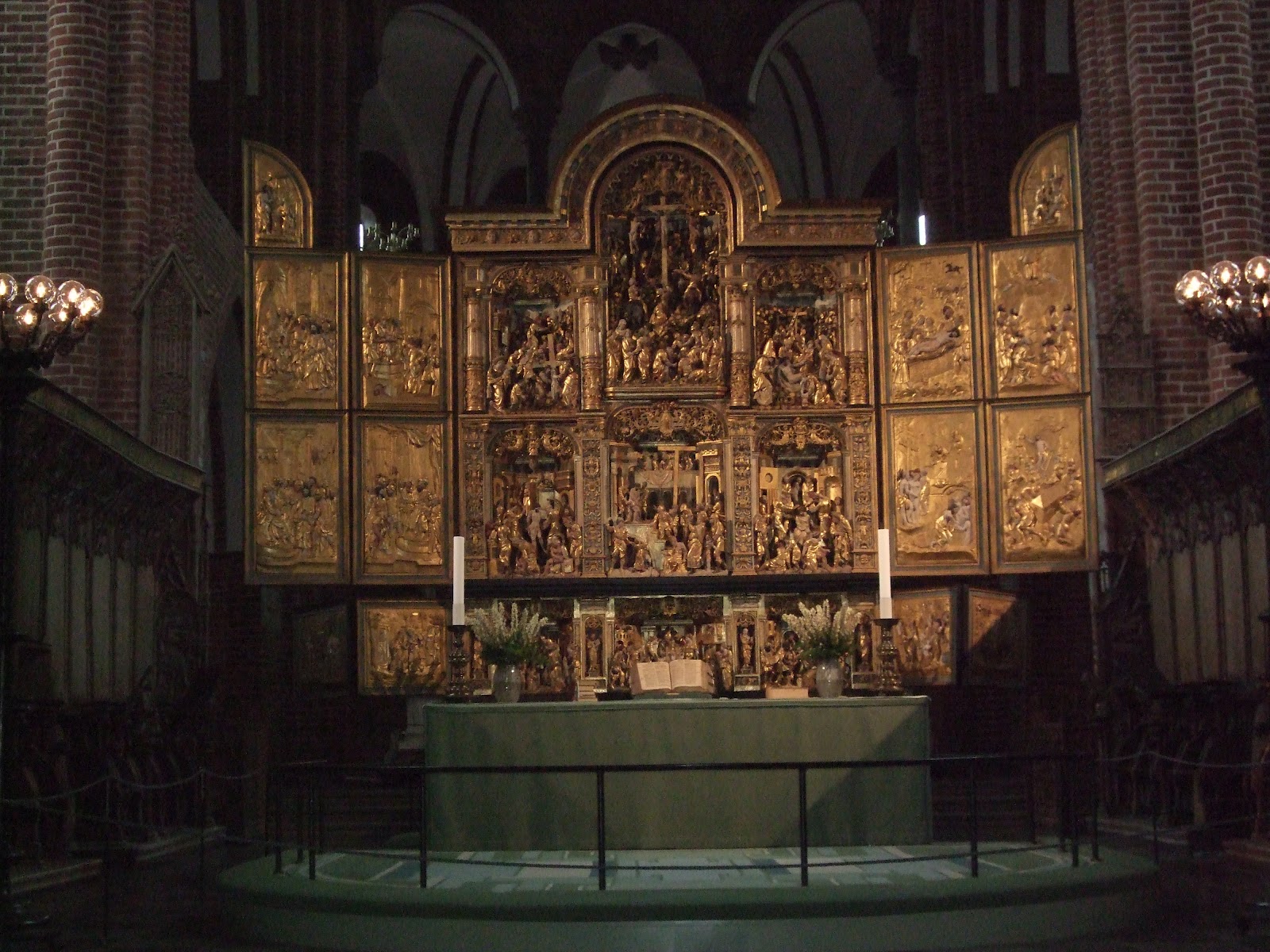 |
| Altar Roskilde Cathedral |
Like many of the Danish churches the interior is quite simple with embellishments on the altar, pulpit and organ and some pictures here and there. I call it ‘muted baroque’ which is a contradiction of terms. Overall it was very interesting and with the entrance fee we received a really good guide.
We started out to the Viking Museum and followed the street directions but we were walking through this park that seemed to lead nowhere and it was still pouring rain. Thinking we were going the wrong way we turned back and went to the Tourist office and asked directions. Ultimately we were going in the right direction, however first we went to the Roskilde palace which has been turned into an experimental art gallery. We looked at some of the exhibits which proved more interesting than we thought they would be.
We decided to have lunch before we went to the Viking Museum. It was still raining as we made our way there. They had found 5 Viking ships that had been scuttled in the harbour the blockade it against attack. Archeologists had painstakingly recovered them and pieced together as to their size and the types of ships they were. They then built replicas of them and the largest one they sailed to Ireland. The museum keeps alive the skills the Vikings used to build their ships. The displays are extremely informative.
 |
| Viking Ship |
By the time we had finished looking at the museum the rain had stopped. We then wandered back into the town to the railway station to make our way back to Copenhagen.
Monday, 25 June 2012
Copenhagen continued
 |
| Helligandskirken |
There are many churches in Copenhagen and we visited many of them. After the Marble Church went to Helligandskirken ( Church of the Holy Spirit) which originally dates back to 1296 when it was part of a Catholic Monastery.. The church is one of the oldest in Copenhagen. It was badly affected by the great fire of 1728 and was largely rebuilt. Then we came across Vor Frue Kirke (Church of Our Lady) which is Copenhagen’s cathedral. It is the third church built on this site and the original 12th century Gothic church was another victim of the 1728 fire while the new church was bombarded by British troops in 1807. The present building dates from 1820. The church is not overly ornate though it has many artworks and statues by prominent Danish artists on display. The Danish monarch Queen Margrethe can often be seen among the congregation on Sundays.
 |
| Rundetarn |
The Rundetarn (The Round Tower) is 33 metres tall and 15 metres in diameter it was erected on the orders of Christian IV and was originally intended as an observatory for the nearby university making it the oldest working observatory in Europe. Access to the top of the tower is via a cobbled ramp, in 1642 during the tower’s opening ceremony Christian IV is said to have ridden his horse up the ramp to the top and in 1716 the Tsar of Russia, Peter the Great was said to repeat the stunt. From the top of the tower there is a wonderful view of the city.
Adjoining the tower is Trinitatis Kirke commissioned by Christian IV for the staff and students of the University. It was inspired by the Gothic style and was completed in 1656 and the roof and interior was destroyed by the 1728 fire it was then rebuilt with Baroque features.
 |
| Tivoli Gardens Entrance |
We were quite churched out after this and decided to visit the famous Tivoli Gardens that night. It is part amusement park and part cultural venue. Tivoli opened in 1843 and is loved and regarded as one of the Danes national treasures. It is in the heart of the city it has a large garden, many rides of various degrees of scariness and a large number of eateries and restaurants which includes Nimb a Michelin star restaurant.
We wandered around and enjoyed the atmosphere and ate at one of the more humble eateries.
The following day we visited Rosenburg Palace which was built in 1606 and contains many royal objects that include paintings, furniture and amoury. In the underground treasury/ vault the crown jewels and other royal treasures. Two armed soldiers guard the front of the treasury. The palace itself is very interesting , in the Long Room there is a collection of silver furniture and tapestries.
We don’t give up, after lunch we wandered across the street to the Danish National Gallery (Statens Museum for Kunst) houses a great collection of European art as well as Danish painters which include artists from the ‘Golden Age’ (1800-50). After we took it all in, with our feet aching we wondered how we managed to survive the Hermitage.
No satisfied with having aching feet from being on them all day we decided to walk to Nyhavn for dinner. I thought I would never be able to walk home but after a glass of wine and a lovely meal my feet were recovered enough to walk back to the hotel.
Saturday, 23 June 2012
Copenhagen June 2012
After 27 hours of traveling and two plane changes we arrived in Copenhagen. We easily bought our train ticket into the city at the airport and our hotel was just around the corner from the station. Even though it was early we were lucky our room was ready, so we had a shower, changed and went off to explore the city.
 |
| Main Hall Radhus |
It is an easy city to walk around and quite compact. So on the first day we managed to visit the Radhus (Town Hall) it was open in 1905 and was inspired by Italian buildings but also is influenced by Danish medieval architecture. The main hall is impressive. The clock tower is a city landmark and its bells can be heard across most of the city. It has a quiet garden courtyard which can be a haven from the bustling streets and the noisy town square in front of the main entrance.
We wandered down the one of the pedestrian shopping streets, took a turn here and there and ended up in front of Christianborg Slot. This place has had a rather chequered history. Originally it was Bishop Absalom’s 12th century fortress which was torn down to build the medieval Copenhagen Castle. The remains which can be seen in an interesting display, which include the remains of the walls. Christain VI (1730-46) replaced the previous building with one of the grandest palaces in Europe. Unfortunately it burnt down in 1794 and was replaced only to be extensively damaged by fire again in 1884. It was rebuilt in 1907 but still is very ornate and sumptuous and remains the seat of the government.
We then continued to the main canal past the Boursen (the former Stock Exchange) which was built between 1590 and 1640 on the order of Christian IV. Today the building houses the Chamber of Commerce and unfortunately is not open to the public. It has a wonderful spire of four dragons with their tails entwined which are topped with the three crowns of Denmark, Sweden and Norway.
We crossed the canal and wandered some more then felt really tired as we made our way back to our hotel. We had an early dinner at an Italian restaurant close to our hotel. We crashed at 8.30pm.
Feeling more refreshed on our second day we decided to go on a canal tour which was very interesting and takes in the statue of the Little Mermaid which has become a symbol of Copenhagen, though it has been vandalized twice. The Little Mermaid is a Hans Christian Anderson story and is rather sad. Many of his stories are poignant which probably reflected the rather his rather sad life.
 |
| Christianhavn |
We passed Christianhavn which in 17th century was the brainchild of Christian IV, the area was originally a swamp but the king decided to acquire the land, drain it and have his nobles live there but they wouldn’t move there. He then decided to encourage merchants to use the area for their warehouses but had to bribe them by giving them the land and exempting them from tax for a number of years.
Until recently this area was known as the ‘free state’ of Christiana and an alternative community sprang up here in the 1970s. Now the rundown buildings have been transformed into trendy restaurants, cafes, offices and apartments.
Overall the canal trip was very informative about Copenhagen and its history.
 |
| Amalienborg Slot |
We visited a number of churches as we made our way to the Rundetarn (Round Tower)
First the Marmokirke (Marble Church) which was modeled on St. Peters in Rome but on a much smaller scale the church was named after Frederik V who wanted it as a celebration of his family’s 300 year rule of Denmark. The work started in 1749 but it ended up costing too much and the work was abandoned.
Wednesday, 9 November 2011
Paris continued
 |
| Montemarte Museum |
We wandered up to Montmarte just for fun as we had been there before but it is an interesting area anyway. We found the Montmartre Museum Montmartre through artifacts, documents, photographs and drawings. It has some wonderful displays relating to Bohemian life that flourish round the area.
From the museum you can see the cabaret-restaurant Au Lapin Agile which in 1900 was popular with artists Picasso and Renoir and poets. It got its name from the humorous painting by André Gill which was a play on words. Afterwards we wandered down the hill and managed to get a bit lost among the tangle of streets but eventually hit a metro station and were once again on track. Then we went to explore the English language bookshop ‘Shakespeare &Company’ the best bookshop in Paris
A walk from our hotel the length of the Rue de Rivoli was very enjoyable.
We treated ourselves to a really nice meal at the restaurant Auberge de la Reine Blanche on the Ile St Louis. Another nice restaurant close to where we were staying on the Rue du Roi-de-Sicile is Feria Café on Rue du Bourg Tibourg.
Reims
A day trip to Reims is easy to achieve especially if you take the magnificent TGV trains, more expensive but quick.
 |
| Reims Cathedral |
Reims is in the Champagne region and it is possible to visit some of the vineyards, but as we just planned a day excursion we confined ourselves to the town. The reason for the trip was to visit the magnificent Gothic cathedral there. The Cathédrale Notre Dame has been the home of the coronation of most French monarchs since Clovis
Next door is the Palais de Tau named after its T-shaped layout. At the end of the 15th century the palace was refurbished and then in the late 17th century. It was mainly used as the archbishop’s palace. Here are housed the treasury of the coronations and the cathedral tapestries as well as statues from the cathedral which have been damaged during shelling in the First World War.
There are also some interesting museums in the town but a lot of them close for around two hours at lunchtime.
We wandered around the town and indulged in a glass of champagne a must really.
It is important to book your seat on the TGV and especially for the return journey. It is best to do it when you arrive at Reims to make sure you get the time you want.
The last full day we had in Paris
We came across the church of Saint Eustache Paris
 |
| Saint Eustache Church |
During our visit a high mass was in progress the beautiful refrain from the choir backed by the organ filled the church which enhanced a spiritual atmosphere.
When the market ‘Les Halles’ which was near St. Eustache moved in 1969 the life of the neighbourhood changed, a cultural centre was built on the market site put the church in a prominent position.
Continuing down the Rue de Rivoli we passed the Louvre and many interesting shops as well as the ubiquitous souvenir shops which sell the same things mainly Eiffel Towers
We discovered two English language bookshops and of course indulged and bought books. We are totally seduced by any bookshop and it’s hard to come out empty handed.
 |
| La Madeleine |
Lunch at a little sandwich shop, further wandering took us to La Madeleine it is a Catholic Church which is designed like a Greek temple in 1764, it is one of Paris
As a suitable conclusion to Parisian interlude on our last night we went back to the Feria Café where we had our first meal.
The next day we left Paris
Wednesday, 2 November 2011
Paris
I have been to Paris
So this time it was good to visit the places not populated by hordes of tourists. Even since 2003 when we were there last the number of tourists has increased considerably.
We stayed at a small hotel in the Marais which was close to the Metro station St. Paul
 |
| Sainte Chapelle |
Close to Sainte-Chapelle is the Conciergie which was a prison in the 1400s. During the Revolution their 4000 prisoners held there, including Marie-Antoinette and Robespierre, before being guillotined. There are very good displays of prisoners’ cells and excellent presentation of its history as a prison and those held there. It still has the Gothic Hall of the Man-at-Arms, where the Royal Guards lived. The building still retains the 11th century torture chamber and 14th century clock tower.
We later visited a small museum of the artist Gustav Moreau a unique and compelling artist. An exhibition of many of his works was a feature at National Gallery of Victoria early this year. His work features Moreau’s obsessions with exotic subject matter, from classical mythology and the ancient world, to some of Christianity’s escapades and the poetic narratives of the Middle Ages. The museum is also his house and the top floor is devoted to his works and thee are a huge number. Much of his work has a Pre- Raphaelite feel to it.
 |
| Hotel de Ville |
The next day we explored the Marais area taking in the Hotel de Ville, a rather ornate building which is the town hall, the official home of the Lord Mayor of Paris
We then walked to the Place des Vosges which is a beautiful square, at the centre a garden surrounded by elegant buildings. It has been the scene for many historical events, which include a tournament to celebrate the marriage of Louis XIII to Anne of Austria in 1615; it was where literary hostess Mme. De Sévigné was born in 1626 and writer Victor Hugo lived for 16 years. He lived at No.6 where his house is now a museum which is very interesting.
 |
| Chateau Vincennes |
The chateau has had some restoration over the years and there is comprehensive information in each area of the complex. It is all very interesting for anyone interested in history.
Monday, 10 October 2011
Vienna
We arrived here in the morning and easily negotiated the subway system to Stephandom. Our hotel the Marc Aurel was not far from there and easy to find. It is a good middle of the road hotel close to the centre of Vienna.
We wandered around re-acquainting ourselves with familiar places. In the afternoon we went to the Albertina as they had an exhibition on Monet and beyond which was worthwhile. We visited the rooms of the palace this time which always prove interesting.
 |
| Ferris Wheel at the Prater |
The following day we visited the Technical Museum which had some wonderful interactive displays. Later in the day we went to the Prater which is a large garden area which was once a hunting ground for the aristocracy. It also has a fun park with the famous Ferris wheel hat was featured in the movie ‘The Third Man’.
When we arrived at the station we saw many people of all ages in the national costume, leather knickerbockers for men and the dirndl outfits for women, which ranged from long skirts to mini skirt versions, some girls even wore the leather shorts as hotpants. There was a wine/beer and music festival and it was fun to watch the various tents with music playing the more traditional music and the enthusiastic participation of the young.
The next day I decided to get out of the city and go to the Vienna Woods. It seemed that Mayerling would be an interesting jumping off point for this. Mayerling is famous as the place where the crown prince and his 17 year old mistress committed suicide together. We arrived and what was there? Nothing! A hotel and a chapel! No paths into the woods. We walked to the next town Alland and being Sunday nothing was open except a couple of restaurants. So we had lunch walked around the town which didn’t take long. We certainly didn’t want to miss the next bus out as they only came once every two hours.
At both Mayerling and Alland there was a map of the Vienna woods but no directions or signposts pointing to possible walks, so the day didn’t quite work out as planned.
The following day we enjoyed walking around the Hofburg area, then went to Karlskirke and back via the Burggarten. It was just nice to sit in the sun
After much discussion as to where we wanted to revisit, we decided on the Belvedere, it was good to do as we were able to appreciate more he paintings we had seen previously. You have more time to reflect on the works. We were surprised that even though it was our second time at the Belvedere we still spent the whole day there.
We revel in just wandering around Vienna looking at the vast range of beautiful buildings. We spent the day around the Rathaus area then we went back to the Vienna Opera House for a tour. It was very informative. Only a small amount of the original building remained after the war. The audience capacity is 1700 and the stage is the largest in Europe. The last treat for us was to have afternoon tea at the Sacher Hotel and have the original Sacher Torte. I must admit it was a bit too much of a chocolate and sugar overdose for me, but the surroundings were wonderful.
The one thing in Vienna I hate is all the ‘Mozart’ music touts you can count over 10 around Stephendom and various numbers around famous buildings. Even with head down and no eye contact you can’t avoid being pounced on, but I still love the place.
Now it’s an overnight train to Freiburg Germany.
Subscribe to:
Posts (Atom)