Monday, 9 July 2012

Bergen - continued

Day 3.  Not content to just do the funicular we decided to go to another close mountain, Ulriken which is accessible by cable car. It is easy to catch the special ‘tourist’ bus there which leaves every half hour from near the fish market. We arrived in time to catch the 10 o’clock bus out, definitely not as popular as the funicular. I had read that there were a number of walks around the area that were worth doing.

Ulriken Mountain

We arrived very enthusiastic to do a bit of hiking, after fueling ourselves with a coffee we investigated possible routes. Choices: easy, demanding or very demanding. Well not knowing how they really graded the trails we decided easy. Next problem was although there was a general map there with the different trails marked there was nothing specific. I asked at the kiosk about the tracks and how to follow them around. The advice was, ‘They only give you destinations, there are coloured poles to follow and it doesn’t matter which way you go, you’ll have a nice walk.’
That wasn’t the instructions I was hoping for but, we can follow the poles, keep the T.V. tower in sight and we should have no problems. When we set out, initially, the trail was obvious and the green poles were easily seen. As we proceeded along the track it became less obvious and it was difficult to tell which was the main track and which were side-shoots. We scrambled here and there, over rocks only to face sheer drops. As we continued we decided that many of the tracks we were following were mountain goat tracks because the only foot prints we could see were those of mountain goats not fellow walkers. The most disappointing thing was that even though we were following mountain goat tracks we never saw one not even in the distance.
We were not impressed with the poorly marked tracks, coloured poles were hard to find and most had barely visible paint on them, no arrows for direction it was basically very poorly organized for such a popular area.
Our short easy walk took on a whole different perspective and by the time we finished it was quite late. We had lunch at the restaurant on the mountain, then back down to catch the bus back to town. By the time we returned every museum was closed.
Day 4.  This is our last day in Bergen and we decided to go to a couple of small museums as we check in for the Hurtigruten at 3.00 pm.

Rozenkrantz Tower


First we went to the Rosenkrantz Tower, it was built in the 1560’s by the governor of Bergen Castle, Erik Rosenkrantz at the command of King Frederik II but there had been a massive fortified tower here erected by King Magnus Lagabøte (the Lawmaker) in 1270. He codified many of the laws some of which seem quite enlightened considering the era they were written.  The present tower was the amalgamation of earlier structures. In 1944 it was badly damaged when a German munitions boat exploded. Restoration work has highlighted the medieval character of the tower. The displays and information in each section was very informative.  
Håkon’s Hall was built between 1247 and 1261 by the king. It was the largest building of the royal residency in the 13th century when Bergen was the political centre of Norway. It was mainly used for grand occasions and was also damaged by the 1944 explosion. It also has been restored and is used today for grand occasions and concerts.
Lastly we went to the Bryggen’s Museum and it has many interesting displays based on archaeological finds in the Bryggen area. The oldest buildings foundations from the 12th century are on display on their original site. Many artifacts and displays showing commerce, shipping, handicrafts and daily life in the Middle Ages are on display and were very interesting.
From here we went to collect or bags and made our way to the wharf to check in for the next part of our trip, up the coast of Norway to Kirkenes on the Hurtigruten one of their passenger cargo ships that plies the coast of Norway every day. Hurtigruten means fast route, it will take seven days to make the journey.

Bergen - Norway

Day 1. Bergen was established by King Olav Kyrre in 1070. Trade was concentrated around the Vagen area and the town grew from there. It grew through the Middle Ages and was a trading centre for much of northern and central Europe and England.
Bryggen - Bergen
From our hotel in the centre of town we walked in the direction of the harbour. The famous fish market was in full swing, all types of seafood on display from giant crab claws to whale meat which looked a distinctly unappetizing black. Next to the fish market a number of stalls were selling a variety of salami made from reindeer, elk and whale, they were offering samples for tasting. I tried the whale but it was not tasty, or maybe I was being prejudice as I’m not in favour of whaling. The promenade between these two markets was full of tourists. Across the road in the square were more stalls selling scarves, beanies, mittens in Nordic patterns and the never ending variety of souvenir t-shirts.
We continued on our way down to the Bryggen, where historic wooden buildings line the shore. Most of the buildings now house cafes and souvenir shops. The souvenir shops all sell much the same merchandise, elks, elks and more elks in any form you like followed by trolls. Though to be fair it is no different from souvenir shops in Australia being replete with kangaroos and koalas in all forms possible.  There were also varying forms of knitwear in Nordic designs, however though the quality is good it would be the case of ‘Would I love it in the morning?’ when looking at them.
Even though we didn’t drive the train from Oslo to Bergen we were feeling rather tired after exploring the town and decided to find a place nearby along the waterfront. We found a restaurant called ‘Zupperia’ which had a menu that tempted us. It was a little busy but even accounting for that the service was extremely slow, though the meal when we eventually got it was good.

View of Bergen from Floien Mountain

Day 2.  We headed straight to the funicular this morning and already there was a long line which quickly got much longer after we arrived. The line moved steadily and it wasn’t long before we had bought our ticket and was on our way up to the Fløien one of the seven mountains that surrounded the town. At the summit we had a great view of the town and the harbour. The day was cool and especially so on the summit so a nice hot coffee was in order. We then walked around and then we walked back down to the town.
We decided to go to the Art Gallery but on our way there was a very good street performer in the square and we stopped and watched for a while and before we knew it the time had got away from us. Still we continued to the gallery thinking we would find a place for a quick lunch on the way. We decided to have a quick lunch at the museum. We then went to buy the ticket and it was quite expensive but would be valid for the next day also as it was entry into the four Art Museums. There was only two we were interested in which was not the place we had lunch. We walked around and eventually found the entrance, it was not obvious, and by this time we would have just over an hour to view anything. We decided we would wait until the next day to make a decision.
I felt there must be some small interesting museum that we could get value out of the short time available as most places close at 4.00pm. First we went to Bergen’s Cathedral. For more than 900 years people have worshipped here. The first church was dedicated to ‘Olav the Holy’ Norway’s patron saint and according to records a church had been built here by 1150. It had been damaged by fire twice in the 13th century and King Magnus had donated money which enabled the Franciscan friars to build a beautiful church.  When the Lutheran Reformation was introduced in Norway the old cathedral was in ruins. The first Lutheran bishop of the area claimed the Franciscan church as the Cathedral.   
We managed to get a very quick look inside as the doors were closed at 4.00pm.  We were able to see the wonderful stonemasonry in the entrance, beautiful windows and portraits of almost all the bishops of Bjørgvin since the Reformation hang there. Aspects of the church were restored in the 1880’s but the Vestry and The Chapter House were completed at the same time as the Cathedral in 1301.
I looked at our information wondering if anything else would be open after 4 o’clock when I saw a museum had an open sign displayed outside. I popped my head in to enquire and found they were open until 5 o’clock.  This was the Hanseatic Museum.
The Hanseatic League originated in Germany. They traded throughout Europe with bases in Bruges, London, Novgorod and Bergen. The Hanseatics were the German merchants in Bergen from 1360-1754. They laid down regulations for their offices internal activities. Its religious needs were met at St Mary’s Church in Bergen. Office staff was required to remain unmarried and celibate. They worked and lived on the premises in rather Spartan conditions. Their living quarters were unheated due to risk of fire. Meals and socializing were in assembly halls with kitchens. The museum was very interesting giving an insight into trade of this area as well as the merchants involved.

Thursday, 5 July 2012

On the way to Bergen- Norway


We caught the train from Stockholm to Oslo mid-afternoon and settled in for a 6½ train journey. We had packed some rolls from breakfast for lunch but by the time we were hungry again  the  kiosk style bistro on the train had run out of anything worthwhile to eat, so we ended up sharing a packet of twisties and a chocolate muffin, hardly a balanced meal. Although the journey wasn’t too tiring we were glad to hear the announcement of our imminent arrival. However, we were all shuffled off our train before we actually arrived at Oslo Central and transferred to buses for an half an hour trip into the city. The one good thing about being in this part of the world in summer is that it doesn’t start getting dark until around 11.00pm, so arriving in a strange city at 10 o’clock at night it was not so arduous for finding our hotel. After settling into our room we enquired if it was possible to get any food at gone ten at night. We were pointed to the pizza place at the next corner and managed to make it 10 minutes before the kitchen closed. By the time we finally settled down it was close to midnight. I put the alarm for 6.00am as we were catching the 8.20 morning train. The journey to Bergen is quite scenic and is worth doing during the day          
I had chosen a hotel close to the station to make it easier to get to the train on time. We were up, packed, though we hadn’t really unpacked, breakfasted and gathered our belongings and proceeded to the station. I like to get to the station early as central stations in European cities are large and it often takes a little time to work out what platform your train leaves from. This is one time being cautious was definitely a good idea. I looked at all the train departure boards and our train did not appear on any of them. We wandered around for a while the minutes seemed to fast tick away. I managed to find a railway employee and showed them my ticket.
‘Go to the bus next to platform 19,’ they said. So off we go and luckily we found it without too much trouble. There were two lines of people neatly corralled behind two signs, one of them saying, ‘Bergen.’ It was all very well organized and we werequickly placed on the bus, many confirming, yes this was for Bergen.
Then we were off. We figured that it had taken us around half an hour to get into the city the previous night so perhaps it would be around the same amount of time. We watch the clock, look at the roads and we seem to be going a lot further. Not actually knowing why we are being bussed or where, we speculated maybe the bus was going to Bergen or if not where.  Down the main highway marked to Bergen, turned off here and there and then after just over an hour we went into a town through the narrow back streets and then dumped off at the station Hønefoss. There we all were like abandoned waifs. Where we were in relation to Oslo or anywhere else in Norway, we had no idea. A number of buses followed ours and dumped more unsuspecting travelers, all waiting like us for the train to Bergen to arrive.
Relieved to see the train, everyone got on quickly and now we were truly on our way. At first the scenery was fairly ordinary but as we climbed into the hills the view was more spectacular. Mountains dotted with snow, ravines, waterfalls, lakes, rivers everywhere you looked. The display in the train gave our altitude and outside temperature, reaching over 900 metres and down to 7ºC.
We arrived in Bergen around 3.00 pm and managed to find the hotel using two rather inadequate maps. Then we were off to explore the town.   

Wednesday, 4 July 2012

Stockholm - continued

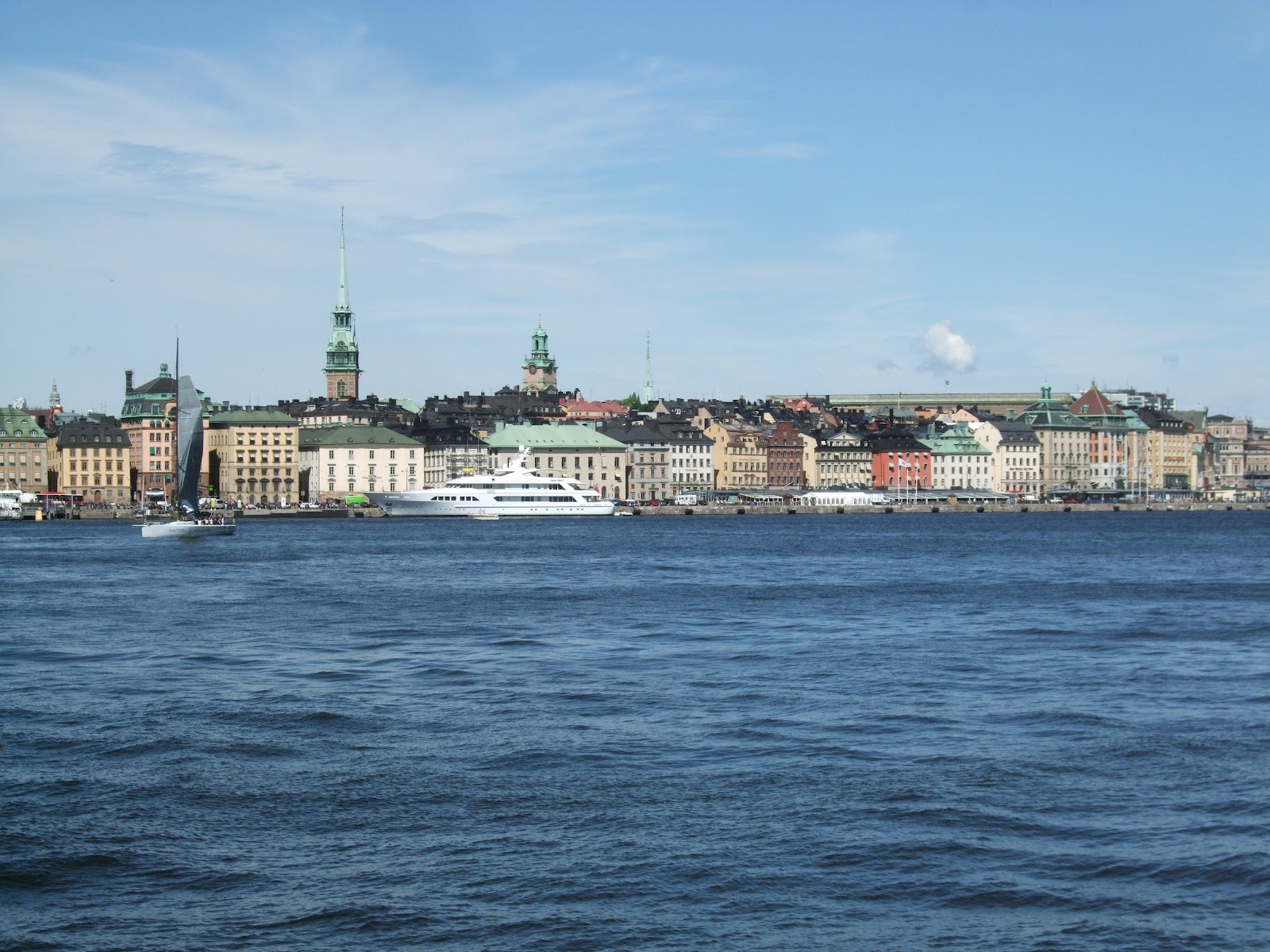
Stockholm from Sodermalm
We decided to a ‘Hop on, Hop off’ Harbour tour which we often find quite interesting, we decided to get off at the island of Södermalm. It is supposed to be the most youthful and bohemian island in central Stockholm. We walked along the coast then up the steps on the granite cliff face. We wandered around and came across Katarina Church which is situated on historic grounds, the Holy Cross Chapel was built on this site in 1320 and there is an association on this site with Stockholm’s Blood Bath of 1520, when many influential people were beheaded, burnt and buried here. A chapel was built in the 1580’s but it soon became too small. A new baroque church was designed in the 17th century. The church was infamous for the witch trials held there in 1675-76.
In 1723 the church as well as 500 houses was burnt in the great fire of the area and much of the church restored. Further restoration took place in the 1950’s but in 1990 it burnt again and so much was destroyed. The building itself was restored but the interior is a blend of old and new which works really well.

Parliament House

In the afternoon we went on a guided tour of Parliament House. For centuries Sweden had a Parliament of the four Estates in society: nobility, clergy, burghers and peasants. In the mid 1800’s this was replaced by a two chamber parliament, whose members were elected by a limited selection of the male population. Universal suffrage did not come into being until 1921. In 1971 the Riksdag (Parliament) switched to a single chamber, made up of 349 democratically elected members. There is proportional representation and members of parliament sit in the chamber according to their constituency and not Party. The Speaker is elected from the members of the chamber then he proposes who he considers for Prime Minister and the members vote on his proposals. The Prime Minister is not necessarily from the majority Party. The Prime Minister then chooses his Cabinet from who he thinks will be best for the job, and are not Parliamentarians. This is the Government, who has to present to Parliament who then votes on various proposals or bills. As a Constitutional monarchy the King is Head of State but he has no other function, he doesn’t sign any documents related to the Government.
Wares that could be sampled at Skansen
Our last full day In Stockholm we spent firstly at the Nordic Museum which proved to be very interesting as it focused on social history. We had an audio guide which we were told would take us about 45 minutes. We took considerably longer. Exhibits included the progression of interiors, fashion, customs etc. We found it very informative. We had lunch at the café there then decided to go to Skansen the outdoor museum a bit like Sovereign Hill in Ballarat. Skansen is the world’s first open air museum is situated on a 30 hectare hill and was created by Artur Hazelius in 1891. The idea was to establish a miniature Sweden, showing how various people lived and worked during different eras. There are around 150 historic buildings from various parts of the country. There are ‘ye olde shoppes’ as well old crafts being demonstrated using techniques from bygone days. Of course all these wares are for sale, but are definitely not cheap. Many would have been nice to have but not suitable for carting half way across the world.

Spire of St. Clara

Our last day in Stockholm was definitely low key; we had ‘museumed’ and ‘churched’ ourselves out. As nothing opens until 10 and it being Sunday so it’s even later and quieter we didn’t rush out. We bought a few bits and pieces and there was just one more church to see which was close to our hotel, St Clara which was part of a convent founded by King Magnus Ladulas in 1280. The convent was dissolve in 1527 during the Reformation. In the late 16th century the church of St Clara was erected by King Johan III on the site of the convent. In the 17th century the tower was added to and was given a new spire. As seemed to be inevitable for many churches and buildings a fire destroyed the steeple, roof, windows and many fittings in 1751.Restoration started immediately and a new roof, steeple, new spire, organ façade and loft constructed. The exterior of the church with its spires looks very impressive and the ceiling decorations inside are tasteful.
We then went back to our hotel to collect our bags to start the next part of our adventure, on to Norway.

Stockholm - June 2012

We arrived in Stockholm close to mid-afternoon. We found our hotel easily, chosen especially as it was close to the railway station. After we divested ourselves of our luggage we explored some of Stockholm.
We made our way to Gamla Stan, the Old Town, we crossed one of the bridges and found ourselves in Riddarholmen (Isle of the Nobility); the elegant buildings of the former Riksdag (Parliament) and several palaces are testament to this. The Riddarholmskyrkan ( Riddarholm Church) dominates the island with it’s an intricate façade with a tall lattice work cast-iron spire. The church was built in connection with a Franciscan monastery which was founded in 1270 by King Magnus Ladulas and was completed in the 14th century. The kings of Sweden have been buried here for the past 500 years their tombs showing various degrees of grandeur on the walls there are hundreds of coats of arms of the Knights of the Order of the Seraphim. The floor of the church contains about 200 graves. The church is now just a museum with the last regular service held in 1807.

Gamla Stan

We crossed the next bridge into the Old Town with its maze of medieval cobbled streets. Antique shops housed in 15th and 16th century buildings many various shops which seem to be dominated by souvenir shops selling the identical merchandise and cafes. The area has a wonderful atmosphere even though it is quite touristy. We visited the German church which is in the heart of this area. The history of the German congregation in Stockholm is interesting. We discovered there was an organ recital early evening so we decided to attend the have dinner. We thoroughly enjoyed the music which was by different composers most we didn’t know but the music was delightful.
We went for dinner at the rather good restaurant that served Scandinavian food and had reindeer which was cooked beautifully and melted in the mouth, it was not unlike kangaroo being a dark and very lean meat.
Even though we hadn’t really done that much for the day other than training it here from Malmö we were extremely tired and was glad to get to bed.
Changing of the Guard
We were now revitalized to tackle our first full day here. Off to the Royal Palace and as we arrived the changing of the guard ceremony had started which was quite interesting but there was a full blown ceremony at midday with more troops and military band, real theatre, which I think all these ceremonies have now become. The guard is conscripted from a number of army, navy and air force units each year and is not an honorary force and is an important part of Stockholm’s military readiness. Although Sweden was once a military power in the Northern Europe, it has not been involved in a war since the early 19th century.
The Royal Palace is built on the site of the original Tre Kronor (Three Crowns) castle which was begun in 1692; however a fire in 1697 followed by a poor economy delayed its completion until 1728. King Adolf Fredrik took up residence there in 1754 and it is still the official residence of the Swedish monarch. It is one of the biggest palaces in the world (over 600 rooms) still inhabited by royalty.
Visiting the Palace takes a good half day. The rococo confection that is the Royal Chapel, Queen Kristina’s silver throne in the Hall of State followed by the Royal apartments and galleries with their ornate baroque interiors and decoration and contains some wonderful 17th century Gobelin tapestries as well paintings, china, furniture and jewellery collected over the centuries. Included in our ticket was entrance to the Treasury which housed the crown jewels, not a lot of recycling of crowns was noted as a number of the different monarchs had their own specific crown made.
Also there was the Tre Kronor museum which presents the history of the castle and Gustav III’s Museum of Antiquities which was basically his collection of Greek and Roman statutory. Gustav III was shot at a Masked Ball as presented in the Opera of the same name, however he died in the palace after two weeks of agony as the doctors couldn’t remove the pieces of bullets lodged in his body.


St. George and the Dragon

Storkyrkan (Great Church) is the oldest church in the city dating back to the 13th century and has been the coronation site for most of the Swedish monarchs. The church has a muted baroque exterior  and the beautiful late gothic interior, however the decorations are ornate and definitely not understated. There is this magnificent sculpture of St. George and the Dragon which symbolize Sweden’s struggle to break away from Denmark. In square near the church, Stortorget (Great Square) a bloody event took place. King Christian II of Denmark in 1520 ordered the beheading of 80 Swedish nobles and piled their heads pyramid style in the middle of the square.
After lunch we walked across to the National Museum of fine Arts which was founded in 1792 when it occupied a wing at the Royal Palace and moved to its current home in a rather impressive Italian Renaissance style building in 1866. The collection covers a wide range of painting with Rembrandts, Rubens, Gauguin, Manet as well as Swedish artists, including Carl Larsson, Anders Zorn and Bruno Liljefors. There was so much to take in we stayed until the museum closed.

Tuesday, 3 July 2012

Malmö Sweden

We left Copenhagen for Malmo around nine in the morning. The trains leave every 20 minutes even on a Sunday. It takes 35 minutes going across the 16 km Øresund Bridge which links the two countries. It’s very interesting looking out the train windows seeing the water on either side so far below.
Malmo is the third largest city in Sweden and has re-invented itself from a rather sleazy, crime ridden place to a trendy cosmopolitan city. It is an easy palace to walk around with some interesting sites.

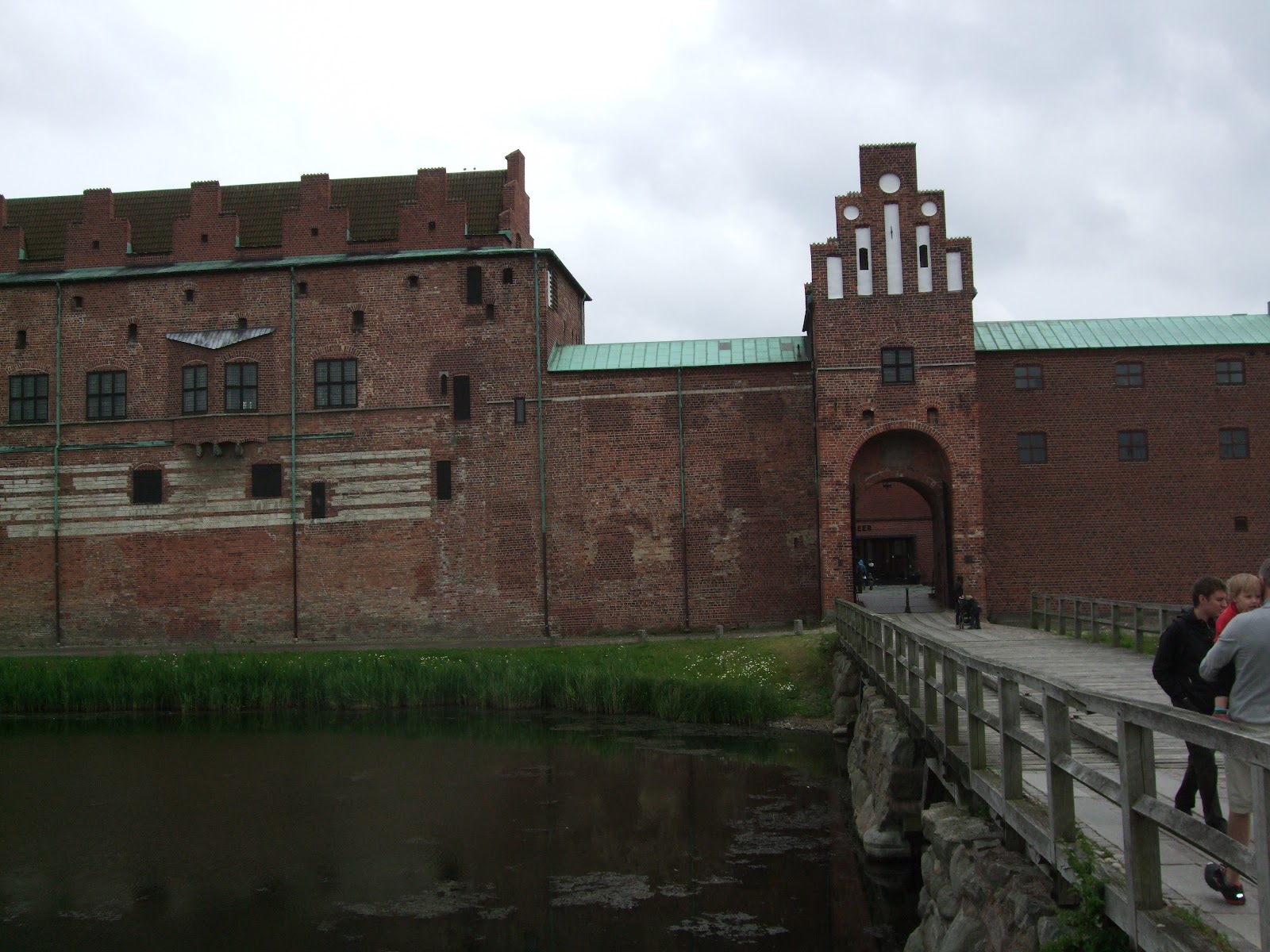
Malmohus Slott

The day we arrived was rather wet and as we arrived earlier than we expected none of the shops were open. After finding our hotel which was near the rather impressive Opera House we made our way to the Malmöhus Slott which houses many interesting exhibits relating to its former uses as a fortress, palace and prison. The whole presentation was extremely interesting.  We then went to the Technical Museum which was just over the road. It had many interactive displays which were very engaging as well as a number of ‘boys’ toys’.
By the time we had spent most of the day in these museums the weather had improved slightly. Not knowing where to go for dinner we headed out from our hotel and just around the corner was a Greek restaurant ‘The Akropolis’ we felt we could work our way through the menu in Swedish as we knew what was likely to be on offer and therefore could work out the dishes reasonably well.
The next day we went to Lund which is only 15 minutes away by train. Lund is a university town and has that special university town atmosphere.  We made our way to the St. Lars Cathedral. It is a magnificent Romanesque Church, after seeing the so many soaring Gothic churches it was a change to see the more solid construction and appreciate this style of construction that preceded the more flamboyant Gothic.
The oldest part of the Cathedral is the crypt and there is a sculpture of a ‘giant’ holding onto one of the pillars. The legend has it that Finn the giant was trying to destroy the Cathedral and when he tried to shake the pillar he was turned into stone.


Astronomical Clock Lund Cathedral

We managed to be there when the Astronomical clock strikes up. The clock dates back to the 15th century but was restored to working order in the early 20th century.  The two knights at the top of the clock clash their swords together to strike the hour, then the music of ‘In Dulci Jublio’ plays as the three Wise Men appear to bow and present Mary and the baby Jesus with their gifts. It is quite magical and going on the number of people who front up to watch it these mechanical devices still fascinate even in these high tech times.

House at Kulturen Museum

As it was a Monday all the museums were closed, however, the Kulturen was open. It was first established in 1892 and comprises an extensive culturally valuable collection and about thirty different buildings showing different eras and styles of architecture. There was an extremely informative display relating to the University of Lund. This is the second oldest open-air museum in the world, the oldest being in Stockholm. The museum was more informative than we thought it would be, as it gave insight into history and society. Once in a museum we seem to lose track of time. By the time we had wandered out of the museum we thought we might as well get back to Malmö. On our return we wandered around the Lilla Torg the old part of the town trying to decide on a place to eat and ended up at an Italian restaurant, which seem as prolific here as they are in Melbourne.
Tuesday our last day here we decided to take a canal tour which was very informative. It certainly filled in a lot of background about the city. One of the main landmarks is the Turning Torso, it’s a remarkable building which twists through 90 degrees from the bottom to the top. It was design by a Spaniard Santiago Calatrava and it is a residential property so it cannot be visited by the public.
After the canal tour we visited the main church St. Petri Kyrka which was built around 1300. This church is known from the medieval seal of Malmö city. The church has gone through a number of restorations and extensions over the ages have not always been kind to maintaining all the historical important aspects. The Reformation caused many medieval adornments and objects to be lost or destroyed but the art objects from the Renaissance and the Baroque were saved. It was an interesting church to visit.
As the day was warm and sunny we explored the Castle gardens which had initially be started by volunteers and there were various garden ‘allotments’ which displayed a variety of design and plants.

Street Sculpture Malmo

We wandered back into town admired the ornate façade of the Radhus, the quirky street sculpture before looking for a place for dinner. We asked at the hotel for a recommendation of a place to eat not too far away and we were pointed in a different direction than we normally would have gone. We discovered this nice little tapas bar, Davidshall, which was obviously out of the tourist area (no English menu) but we managed to bumble along and had a really nice dinner.
Then first thing the next day off to Stockholm.

Copenhagen - last day

Vol Freslers Kirke's Spire
Our last day in Copenhagen was bright and sunny. We decided we would investigate the Christianhavn area. We thought there might be some markets there but we were mistaken. We then went to Vor Frelsers Kirke (Our Saviour’s Church) which is famous for its unusual spire. Built in 1752 the spire is accessible via an external spiral staircase. There are 400 steps to the top from where there is a wonderful view of the city. I thought I wouldn’t have the stamina to make it to the top, but slow and steady I got there. Yeah!
The church itself is an ‘understated’ Baroque confection with the altar adorned by cherubs and a huge ornate organ with over 4000 pipes dating from 1698.
We love libraries and went across to the Royal Library. A new building is called the Black Diamond because when the number of black glass panels reflects the light it sparkles like black diamonds. This part of the library is attached to the historic building. The old library had the hallowed atmosphere one expects in such places. To our surprise in the new section they had this wonderful display of some of their treasures. These included a Gutenberg Bible printed on parchment originally 180 were printed and now only 49 remain. There was the original typed manuscript of Karen Blixen’s ‘Out of Africa’, she typed it in English then hand wrote the Danish translation above. Also include were Hans Christian Andersen’s manuscripts, work of Ptolemy. Tachue Brahe’s astronomical Observation Book and a Bach signed musical manuscript, just to name a few. It was magical. That killed most of our time for the day.
We decided we would look for some souvenirs and have come to the conclusion they were all rather tacky. There is the very expensive and great Royal Copenhagen china, great design for household goods or just plain not so cheap rubbish. So we bought nothing.
The next day we would be off to Malmo in Sweden across the Øresund Bridge which links Denmark and Sweden with a 16km bridge.