Thursday, 12 December 2013

Split-Croatia Sept 2013


We arrived in Split at around 2.00 p.m. and went in search of our accommodation .It wasn’t that far from the bus station, the trick however was to find it. I managed to work out the direction and knew it had to be off the main road, but the name of the street where it should be didn’t match up. I managed to find someone to give me directions. We weren’t far away just needed to go under the arch just a little way down the road and we would be there.

Main Square in the centre of the Palace
That was negotiated easily and as we walked up the narrow road, again a man came hurrying down to help us, and again it was the woman who did all the work of running the establishment. Dalmatian House is in a great location not far from the old town. Our hostess was very helpful and even did our laundry for us when I enquired where I could get it done. We gave here our laundry, she gave us a map, pointed out some good places to eat and we were off to explore.

Split is an interesting town which has been built within the ruins of Diocletian’s Palace. Shops, houses are crammed into a spider-web of narrow lanes. It is wonderful to wander through the lanes turning this way and that to see where you end up.

One of the laneways

In the centre of the palace the Emperor’s Mausoleum was transformed into the Catholic Cathedral in the 7th century. Diocletian was Emperor (284-316); he was one of the greatest Roman emperors. It took him 10 years to build the palace in Split. Opposite the Cathedral is the Temple of Jupiter which has been turned into a Baptistery.

We also went into what is now called the basement halls which were originally the ground floor. The original palace was right at the water’s edge so I imagine the ancient ships sailing up to its outer walls and doors.

From there we decided to check out the Maritime Museum. There were some interesting exhibits, though I skipped through a lot of the military stuff, however, one exhibit which caught my attention was who developed the concept of the torpedo and its history. Another exhibit was a fish holding jar, which after fish have been caught, but still alive are place in a large jar with holes in the side which is subsequently placed in the sea, fresh fish, that can’t escape.

It did bucket down with rain for a short period of time which we were lucky to miss as we were in a shop at the time. After lunch we walked along the shore and up the hill to Marjan Park. We popped into a little Franciscan Church which we passed on our way.


View from Marjan Park

We climbed a number of steps there was a little Jewish cemetery located at the top. From the top there was also a wonderful view of the town and coastline.

We ate dinner at a restaurant recommended by our hostess, Fife which was by the waterfront. It was certainly worth going to, the food was good and very reasonable, as obviously very popular with locals and tourists alike.

On our last day we wanted to have a ‘boating’ experience but not have a whole day tour, we took a ferry to Brač an island more noted for resort style holidays than history. It was very pleasant journey across. The main town Supetar is very small; exploring any of the interesting places didn’t take that long. We had a rather nice lunch overlooking the sea, wandered around the coast then made our way back in time to catch the next ferry back to Split.

The next day we left for Dubrovnik and as we handed back our keys to our hostess she gave me a little present as a souvenir. It was a very nice touch.

Plitvice Lakes- Croatia Sept. 2013

The bus journey to the Plitvice Lakes was longer than I imagined, we arrived after lunch. When the bus arrived at its last stop we alighted looking around checking our paper for the address of our accommodation. The bus driver gestured to us to look at the address and pointed to us to get back on the bus and then stopped outside the place we were staying, which was at the previous stop.

We were greeted by a man running down the path eager to take our bags to our accommodation. The House Samardzic was very picturesque and the woman who ran very friendly and helpful. She showed us to our room which was basic and clean with all the usual amenities including free Wi-Fi.

We left our bags in our room ready to go to the lakes; our hostess said her son would drive us up there as he was going out anyway. Offered to cook us dinner there that night (obviously to be paid for) to which we heartily agreed as it would save us looking for a place,

One of many waterfalls
So we were off to the Plitvice Lakes National Park, the park has numerous lakes and waterfalls. The many lakes are formed from the sediment formed from the calcium carbonate from the water. It builds barriers along with algae which causes various separate lakes to form. We managed to complete one walk that day marveling and the beautiful scenery and waterfalls. The water so clear that even in the deeper sections fish could be seen swimming on the bottom.


Pristine and clear water of the lakes
We walked back to our accommodation along the main road, not the safest way to go as there was no actual ‘footpath’ space on either side, which made it rather scary when cars and buses whizzed by.

We had a delicious dinner our meal was three course with cold meats and olives to start and delicious fish main and cake to finish with. We were plied with rakia which was quite potent.

The next day we were up early to have breakfast, ready to face a whole day at the lakes. We did a different walk which took us longer, everywhere one looked was spectacular, and even though there were a lot of people there it didn’t spoil the experience. Many of the paths are on boardwalks as the ground in places is quite marshy. We went on a boat ride across one of the lakes and walked along the banks. By the time we finished walking all day we decided to make our way back to our room. Before leaving we pre-bought our ticket for the bus the next morning.

View of the Lakes

We were lazy again and had our dinner at the guest house, a meat meal this time, though I thought the fish meal was better, but it still was a homely nourishing meal.

The next day we were up early for breakfast as we were catching our bus at 9.30, but were lucky as the bus stop on the main road was just opposite the pathway from the guest house.

We were thankful to see the bus as it arrived a bit late. We were now on our way to Split. One bizarre thing that on the way there is part of the road about 7 km which goes through Bosnia, so we had to have a customs check. This road was probably constructed when there was a Yugoslavia and not separate countries so the route of the road wouldn’t have been an issue.


Zagreb- September 2013


We caught the train from Ljubljana to Zagreb, early the journey was quite slow and included a border station where immigration officials from both countries checked our passports.


When we arrived mid- morning and it was heartening to see our hotel virtually opposite the railway station as we had no map it certainly made it so much easier. We were soon booked in then grabbed ourselves a free map and went to explore the city.

Zagreb the capital of Croatia has a population of nearly one million contains almost a quarter of its people.

There are many interesting places and the vibrant street life makes it an enjoyable city to visit. We started our orientation by walking away from the station past many beautiful buildings arriving at the square in front of the cathedral which still dominates the skyline with its neo-Gothic style and is surrounded by well- preserved Renaissance walls. The Cathedral was first constructed in 1093 but was destroyed by the Tartars in the 13th century. The Ottomans invaded in the 15th century and constructed the walls around it. In 1880 it was badly damaged by an earthquake and the facade was reconstructed in 1906.

Not far from the Cathedral is a lively food market. Markets are always interesting to walk around. We admired the large juicy tomatoes which are full of flavour. Finding a place to eat was not difficult as there are restaurants and cafes everywhere, it’s more of a matter as to what one wants to eat. We found a small café which sold absolutely delicious simple hamburgers.

Zagreb is divided into an Upper and Lower Town. The Lower Town is newer and the streets were planned on gridlines and must be the same width and all buildings the same height and type, included in this plan were many parks and squares with an abundance of neo-classical buildings which makes walking around the town a delight.

Our second day here we went to the Modern Art Gallery. It was extremely interesting and broad selection of art from various eras across Europe as well as a good selection from Croatian artists. We also visited the Technical Museum another interesting place. They had a ‘Tesla Laboratory’ set up and had demonstrations relating to his experiments with electricity. Nikolai Tesla was instrumental in the development and introduction of alternating current, x-rays, remote control devices and radio waves Although the commentary was only in Croatian we were able to understand the gist of what was being demonstrated, it is handy if you have some science background though. The demonstrator spoke some English as we spoke to him afterwards.

The Upper Town is entered via the Stone Gate, the only town gate that has remained intact and was originally built in the Middle Ages. Under the arch of the gateway is a chapel dedicated to the Virgin Mary. It holds the painting of the Virgin that was miraculously saved from a devastating fire in 1731. The chapel is still a place of pilgrimage. Prayer services take place regularly and many people make private devotions. The chapel is not enclosed and you wander through the gate and can find yourself in the midst of devout pilgrims. Sensitivity is a must.

St. Mark's Church
In the heart of the Upper Town is St. Mark’s Church which is a 13th century Romanesque Church; however it was substantially rebuilt in the 19th century. The roof tiles, which are reminiscent of Stephansdom in Vienna, are decorated with the coat of arms of the Triune Kingdom of Croatia, Dalmatia and Slovenia.

We walked in and out the narrow streets and lanes of the Upper Town passed a Museum of Broken Relationships (bizarre); there were a number of other small museums in this part of the city.

While we were here in one of the large squares a Vegan Festival was being set up. On our last day in the city, which was a Saturday the festival was in full swing. So we wandered around the various stalls. We tried the ice-cream on one stall. They had some very interesting flavours which in included lemon and mint, very refreshing and apricot and rosemary the combination really worked. There were children’s performances and overall it was very enjoyable.

The Vegan Festival

We walked around some of the little lanes near the market as we were having a coffee a group of women in national costume appeared and sang some traditional songs. Then there was a parade of people dressed in animal costumes which I think was related to the Vegan Festival. The weather was great and it was just lovely to wander around taking in the atmosphere.

Part of the street parade
While having something to eat another street parade took place of men in historical military uniforms both on foot and on horses. One guy with his rather bushy moustache on his horse looked as though he had just returned from the Battle of Balaclava. It seems that these types of displays are held most weekends which are great for both tourists and locals alike.  

One of last locations to visit was the Botanical Gardens which run parallel to the railway tracks, according to the blurb there is a collection of 10,000 plant species, ranging from the exotic to indigenous Croatian plants. However the gardens overall were very disappointing, the poor layout and the lack of labeling didn’t help either.

Oneof the 'Guardians' of the City
There are many interesting places to visit in Zagreb and our stay was extremely enjoyable. Outdoor stalls in parks and entertainment, cafes, markets and just the buzz of the city make it a great place to visit. As you walk around the city look up, if you look carefully you will notice unusual characters on façades, balconies and posts, towers, next to windows and above doors. Beasts, demons, dragons, owls, angels and spirits are not just mere decoration but are ‘guardians’ of the city. The tourist office has two great books called ‘Zagreb’ and ‘Step by Step Zagreb,’ just pop in and ask for them. The information contained in them will keep you exploring every nook and cranny of the city.


The next day we were off to the Plitvice Lakes. We had bought our bus ticket and as the tram that went to the bus station passed our hotel it made it very easy to get ourselves and our luggage there.

We caught the train from Ljubljana to Zagreb, early the journey was quite slow and included a border station where immigration officials from both countries checked our passports. When we arrived mid- morning and it was heartening to see our hotel virtually opposite the railway station as we had no map it certainly made it so much easier. We were soon booked in then grabbed ourselves a free map and went to explore the city. Zagreb the capital of Croatia has a population of nearly one million contains almost a quarter of its people. There are many interesting places and the vibrant street life makes it an enjoyable city to visit. We started our orientation by walking away from the station past many beautiful buildings arriving at the square in front of the cathedral which still dominates the skyline with its neo-Gothic style and is surrounded by well- preserved Renaissance walls. The Cathedral was first constructed in 1093 but was destroyed by the Tartars in the 13th century. The Ottomans invaded in the 15th century and constructed the walls around it. In 1880 it was badly damaged by an earthquake and the facade was reconstructed in 1906. Not far from the Cathedral is a lively food market. Markets are always interesting to walk around. We admired the large juicy tomatoes which are full of flavour. Finding a place to eat was not difficult as there are restaurants and cafes everywhere, it’s more of a matter as to what one wants to eat. We found a small café which sold absolutely delicious simple hamburgers. Zagreb is divided into an Upper and Lower Town. The Lower Town is newer and the streets were planned on gridlines and must be the same width and all buildings the same height and type, included in this plan were many parks and squares with an abundance of neo-classical buildings which makes walking around the town a delight. Our second day here we went to the Modern Art Gallery. It was extremely interesting and broad selection of art from various eras across Europe as well as a good selection from Croatian artists. We also visited the Technical Museum another interesting place. They had a ‘Tesla Laboratory’ set up and had demonstrations relating to his experiments with electricity. Nikolai Tesla was instrumental in the development and introduction of alternating current, x-rays, remote control devices and radio waves Although the commentary was only in Croatian we were able to understand the gist of what was being demonstrated, it is handy if you have some science background though. The demonstrator spoke some English as we spoke to him afterwards. The Upper Town is entered via the Stone Gate, the only town gate that has remained intact and was originally built in the Middle Ages. Under the arch of the gateway is a chapel dedicated to the Virgin Mary. It holds the painting of the Virgin that was miraculously saved from a devastating fire in 1731. The chapel is still a place of pilgrimage. Prayer services take place regularly and many people make private devotions. The chapel is not enclosed and you wander through the gate and can find yourself in the midst of devout pilgrims. Sensitivity is a must. In the heart of the Upper Town is St. Mark’s Church which is a 13th century Romanesque Church; however it was substantially rebuilt in the 19th century. The roof tiles, which are reminiscent of Stephansdom in Vienna, are decorated with the coat of arms of the Triune Kingdom of Croatia, Dalmatia and Slovenia. We walked in and out the narrow streets and lanes of the Upper Town passed a Museum of Broken Relationships (bizarre); there were a number of other small museums in this part of the city. While we were here in one of the large squares a Vegan Festival was being set up. On our last day in the city, which was a Saturday the festival was in full swing. So we wandered around the various stalls. We tried the ice-cream on one stall. They had some very interesting flavours which in included lemon and mint, very refreshing and apricot and rosemary the combination really worked. There were children’s performances and overall it was very enjoyable. We walked around some of the little lanes near the market as we were having a coffee a group of women in national costume appeared and sang some traditional songs. Then there was a parade of people dressed in animal costumes which I think was related to the Vegan Festival. The weather was great and it was just lovely to wander around taking in the atmosphere. While having something to eat another street parade took place of men in historical military uniforms both on foot and on horses. One guy with his rather bushy moustache on his horse looked as though he had just returned from the Battle of Balaclava. It seems that these types of displays are held most weekends which are great for both tourists and locals alike. One of last locations to visit was the Botanical Gardens which run parallel to the railway tracks, according to the blurb there is a collection of 10,000 plant species, ranging from the exotic to indigenous Croatian plants. However the gardens overall were very disappointing, the poor layout and the lack of labeling didn’t help either. There are many interesting places to visit in Zagreb and our stay was extremely enjoyable. Outdoor stalls in parks and entertainment, cafes, markets and just the buzz of the city make it a great place to visit. As you walk around the city look up, if you look carefully you will notice unusual characters on façades, balconies and posts, towers, next to windows and above doors. Beasts, demons, dragons, owls, angels and spirits are not just mere decoration but are ‘guardians’ of the city. The tourist office has two great books called ‘Zagreb’ and ‘Step by Step Zagreb,’ just pop in and ask for them. The information contained in them will keep you exploring every nook and cranny of the city. The next day we were off to the Plitvice Lakes. We had bought our bus ticket and as the tram that went to the bus station passed our hotel it made it very easy to get ourselves and our luggage there.

Sunday, 22 September 2013

Ljubljana - Slovenia Sept. 2013


We arrived at Ljubljana station and we took what seemed the best way to our hotel, but it actually turned out more complicated after we discovered where it was. The Hotel Park is in a good location with easy access to the centre of the city and the railway station.

Ljubljana is a small compact city which is not surprising considering the whole country has only 2 million inhabitants. Emona was the Roman predecessor of Ljubljana and numerous remains of this past can still be seen.

One of the interesting features is the castle situated on the hill overlooking the city. There has been a castle there since medieval times and has gone through many renovations and extensions over the centuries. It’s only been relative recently that it has been given a new life as museum, dining and entertainment options, as well as these it also has a permanent exhibition on Slovenian history as a ‘Virtual Castle’ which presents the history of the castle itself. Both are well worth viewing.
View of Ljubljana from Castle

 
It was delightful walking along the river past the numerous ice-cream cafes and restaurants. A guided boat ride down the river proved interesting pointing out the importance of the various bridges, for example the Dragon Bridge and the Triple Bridge we also passed and some of the new architecture which is away from the centre of the town. The town centre has some interesting churches; the Franciscan Church of The Annunciation is a good example of early Baroque architecture, while on the opposite side of the river the Baroque Cathedral of St. Nicholas housing some charming frescoes. There are many other beautiful buildings in the city; however, it seemed that just about everywhere there was an enormous amount of graffiti which took a lot away from the city. We mentioned this to the guide on the boat and he said that they clean it up every two months, but most of what we saw had been there way longer than that.
Dragon Bridge

I decided to be crazy brave and hire a car for two days to see some interesting features away from the city. Why brave? As we drive on the left side of the road I have to think every aspect of driving in the opposite way.

We picked up the car early in the morning. I was given directions to get out of the city and onto the motorway. I was like a learner driver, stalling the car, not getting into the correct gear etc. but managed to get out of the city without causing an accident.

Our first stop was the Postojna Caves which are 53kms from Lubljana. The cave system runs for 27kms. Tourism to these caves has occurred from1819 which small carts on tracks pulled by people transported tourist into the cave system, now a more mechanical system with many carriages does the job. Amazing and stunning is the only way to describe the stalagmite and stalactite formations. I have seen many caves over the years but these were the biggest and most beautiful I have seen so far.

From there we went to Predjama Castle. First we decided to have lunch here and as there was a café we decided to have a quick bite to eat. The person who served us must have learnt his serving skills from ‘Fawlty Towers’ he seemed annoyed that we actually wanted to order food and when it arrived it was less than average.

Predjama Castle

The castle itself was very interesting as it was built 800 years into a 123 metre cliff. It was used purely for defensive purposes as to live in would have been extremely draughty

We then went the Skojan Caves; this is a unique cultural heritage site and has been included on the UNESCO World Natural Heritage List. The cave system includes numerous caves and passages, collapsed dolines, natural bridges and sinkholes. Many parts of this cave system are only accessible to experienced cavers. The subterranean stream of the Reka River has created this cave system and has been known to flood the whole cave system. It is impossible to compare the two sets of caves we saw as they were very different, but were both spectacular in their own way and both were well worth visiting.

After a day of driving I was improving though I did tend to bang the wheels into gutter a number of times. We managed to get back to the city before dark and with beginners luck reached our hotel without too many dramas.

The next day it was to the lakes. I woke up to face another days driving, the day before I was confident in my ignorance, now reality had set in. We started out sure of our directions out of town only to end up on a different road out but found we were on the motorway in the direction we needed to go.

Lake Bled was our first destination, when we arrived it was exceedingly busy. I drove part of the way around the lake, around the town and it was impossible to find a park. We then decided after we had wasted enough time to continue to Lake Bohnj which is 75kms from the city.

Lake Bohnj is a very peaceful setting and many people camp there as it is a base for hikes into the Julian Alps. It is also famous for its cheese. We took a cruise around the lake which was very informative. The whole setting is a picture postcard.
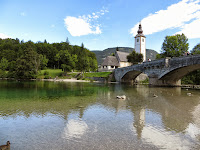
Lake Bohnj

The Church of St John the Baptist is in a dominant location on the eastern part of the lake. It is thought to have been constructed in the middle of the 11th century. Both inside and out it abundantly decorated with frescoes that date from the 14th to 16th century. The church’s most famous fresco is found on the outside is that of St. Christopher. Though it is only a small church it has many features that make a visit worthwhile. We had a lunch at nice little hotel restaurant then headed for Radovljica.

Radovljica is a delightful little town which was easy to negotiate and more importantly found a place to park the car. Our reason for going there was the Apicultural Museum. This useum is housed in a beautiful baroque manor house in the old part of the town.

Bee keeping may seem a boring topic for a museum but the history and development as well as everything there is to know about bees is fascinating. Slovenia has been important in the development of bee keeping. The indigenous honeybee, the Grey Bee of Carniola has been exported to just about every country in the world. There is much to keep you occupied for a couple of hours. A delightful little part of Slovenian folk culture is the paintings on the front of the beehives which have mainly religious or humorous subjects.

We then decided to face Bled again thinking that we may be able find a park later in the day. So back we went and luckily we found a park. Down to the lake and this too was very picturesque with a little island in the middle on which there was a small church of The Assumption A traditional ‘pletna’ boat takes people across to the island. The boats are very similar to gondolas, except that the oarsman uses two oars at the back instead of one. We took this very pleasant ride and enjoyed visiting the church, which features a free standing bell tower and had to be rebuilt after an earthquake in the 16th century.

Lake Bled

By the time we had returned to the mainland it was getting late, Bled Castle which looks down over the lake from a rocky hill top would’ve been closed by the time we would’ve made it to the top so we decided that the outside view would have to do. Friends who had visited Bled late autumn and in winter have said the town is virtually deserted. After our experience of trying to negotiate the crowds in early autumn I would advise to either go on an organized tour (no parking worries) or go during a colder month.

Finding where we parked our car was a bit of a trial but we eventually found it and headed back to Ljubljana. It was later than the previous day so as we were heading into the city it was all but dark. We also had to fill up the petrol tank for returning purposes. We knew there was a petrol station just after we left the motorway, with the tank full we had to negotiate the city streets, some being only one way back to the hotel where we hired the car. After a few wrong turns and not having a clue where we were a ‘guardian angel’ must have showed me the way which had a sign with ‘Grand Union Hotel’ with an arrow showing the direction. Guiding the car into the designated car park I was relieved to hand back the keys.

On our last day in Ljubljana we went to the Art Gallery, which was rather disappointing considering it is a gallery of a capital city. We also went to the Slovenian Museum which was also unremarkable. We wandered around the town and just enjoyed a quiet last day. Early the next day we were off to Zagreb.


Friday, 20 September 2013

Vienna August 2013


After what seemed like an interminable journey we arrived in Vienna and easily got from the airport to Stephanplatz. There is a fast train connection which made getting there easily accessible. Melbourne please note. As we were staying at the same place as last time, Marc Aurel Hotel we had no trouble finding our way. It is in a great location and really nice little hotel not far from St. Stephan’s Cathedral.

The first afternoon we just wandered around our area as we were feeling very tired. Even if you haven’t been to a city before it is always good to just wander around the first day to orientate yourself.

The next day we went to the Jewish Museum, it was closed last time we were there. It was very interesting as it wanted to feature what Jewish Culture was like in Vienna but also included crucial information about the treatment of the Jews during under the Nazis. The Jewish Museum in Vienna initially was first set up in the late 1800s by the Jewish community. It is located near the Hofburg complex.
State Library


After we spent quite a while there we then went to the State Library, which is definitely worth seeing. We had been there on a previous visit but have a soft spot for old, opulent libraries. As on our previous visit there was an exhibition, this time on documents that charted aspects of Austrian history.

Then not content with this we managed to find time to go to the Mozart House which presented an insight into the life and times of Mozart as well as some very interesting information about his life.

By the time we had walked our feet off for the day we had dinner at our hotel restaurant. We had eaten there on the previous visit and the food has been very good and it didn’t disappoint this time.

The next day we visited Melk which is about an hour and 20 minutes by train from Vienna. A huge abbey dominates the town. The abbey is considered a masterpiece of baroque art. It is now a museum but for over 900 years was a Benedictine monastery. It served over the course of its history as an educational institution and carried out religious duties to the parish.
Melk Abbey


It is easy to spend most of the day in the abbey and gardens.

Spurred on by our trip to Melk we decided to venture to Rust which is situated by Neusiedler Lake. We had to take a bus there and the bus station was in disarray as there was a huge amount road works in progress around it. We found where the buses left and knew the number, 566, on seeing a bus with that number, even though it had ‘Eisenstadt’ as its destination, and was earlier than the time we were given, decided to check with the driver. ‘It’s Ok; you can change at Eisenstadt and catch bus 765 to Rust.’ I thought this would be a good option as we could probably arrive at Rust a bit earlier than expected. However being school holidays some of the scheduled buses were not running, so instead of a five minute wait we had a 30 minute wait and arrived at Rust 15 minutes later than the direct bus. The town has some interesting buildings; the Town Hall (Rathaus) was built in 1673. The town was fortified twice and there are still remnants of the old town gate and wall left. A trip on the lake was an enjoyable way to spend an
Rust
hour. It was disappointing that the Fischerkirche was closed as it seemed to be the most interesting. Overall the town was definitely worth a visit but I think the direct bus is the better way to go if just doing it as a day trip.

On our last day in Vienna we visited the Secession Building an unusual building designed by Joseph Maia Olbrich for the Secessionist movement artists. We had seen some advertisements for the Gemälde Galerie which wasn’t far from the Secession Building; it is the paintings gallery of the Academy of Fine Arts. It has a small collection but excellent cross-section of the history of European painting. The collection was donated to the Academy in 1822 by Graf Lamberg-Sprinzenstein. Another delightful aspect of the gallery was the very interesting discussion we had with the ticket seller.

From there we went to the Hundertwasser Haus is an apartment block designed by Austrian artist Friedensreich Hundertwasser. The colours and irregularity of the walls is very much a reminder of Gaudi architectural style. 
Hundertwasser House

Our last activity for our last day was a ‘Third Man’ walking tour, which was not a sewer tour (as it turns out none of the sewer scenes in the movie were actually shot in Vienna’s sewers). It was very interesting from both a cinematic and historical point of view. Well worth doing but it’s better if you have actually seen the film and I will certainly watch it again with a completely different eye.

Early the next morning we left Vienna for Slovenia


After what seemed like an interminable journey we arrived in Vienna and easily got from the airport to Stephanplatz. There is a fast train connection which made getting there easily accessible. Melbourne please note. As we were staying at the same place as last time, Marc Aurel Hotel we had no trouble finding our way. It is in a great location and really nice little hotel not far from St. Stephan’s Cathedral. The first afternoon we just wandered around our area as we were feeling very tired. Even if you haven’t been to a city before it is always good to just wander around the first day to orientate yourself. The next day we went to the Jewish Museum, it was closed last time we were there. It was very interesting as it wanted to feature what Jewish Culture was like in Vienna but also included crucial information about the treatment of the Jews during under the Nazis. The Jewish Museum in Vienna initially was first set up in the late 1800s by the Jewish community. It is located near the Hofburg complex. After we spent quite a while there we then went to the State Library, which is definitely worth seeing. We had been there on a previous visit but have a soft spot for old, opulent libraries. As on our previous visit there was an exhibition, this time on documents that charted aspects of Austrian history. Then not content with this we managed to find time to go to the Mozart House which presented an insight into the life and times of Mozart as well as some very interesting information about his life. By the time we had walked our feet off for the day we had dinner at our hotel restaurant. We had eaten there on the previous visit and the food has been very good and it didn’t disappoint this time. The next day we visited Melk which is about an hour and 20 minutes by train from Vienna. A huge abbey dominates the town. The abbey is considered a masterpiece of baroque art. It is now a museum but for over 900 years was a Benedictine monastery. It served over the course of its history as an educational institution and carried out religious duties to the parish. It is easy to spend most of the day in the abbey and gardens. Spurred on by our trip to Melk we decided to venture to Rust which is situated by Neusiedler Lake. We had to take a bus there and the bus station was in disarray as there was a huge amount road works in progress around it. We found where the buses left and knew the number, 566, on seeing a bus with that number, even though it had ‘Eisenstadt’ as its destination, and was earlier than the time we were given, decided to check with the driver. ‘It’s Ok; you can change at Eisenstadt and catch bus 765 to Rust.’ I thought this would be a good option as we could probably arrive at Rust a bit earlier than expected. However being school holidays some of the scheduled buses were not running, so instead of a five minute wait we had a 30 minute wait and arrived at Rust 15 minutes later than the direct bus. The town has some interesting buildings; the Town Hall (Rathaus) was built in 1673. The town was fortified twice and there are still remnants of the old town gate and wall left. A trip on the lake was an enjoyable way to spend an hour. It was disappointing that the Fischerkirche was closed as it seemed to be the most interesting. Overall the town was definitely worth a visit but I think the direct bus is the better way to go if just doing it as a day trip. On our last day in Vienna we visited the Secession Building an unusual building designed by Joseph Maia Olbrich for the Secessionist movement artists. We had seen some advertisements for the Gemälde Galerie which wasn’t far from the Secession Building; it is the paintings gallery of the Academy of Fine Arts. It has a small collection but excellent cross-section of the history of European painting. The collection was donated to the Academy in 1822 by Graf Lamberg-Sprinzenstein. Another delightful aspect of the gallery was the very interesting discussion we had with the ticket seller. From there we went to the Hundertwasser Haus is an apartment block designed by Austrian artist Friedensreich Hundertwasser. The colours and irregularity of the walls is very much a reminder of Gaudi. Our last activity for our last day was a ‘Third Man’ walking tour, which was not a sewer tour (as it turns out none of the sewer scenes in the movie were actually shot in Vienna’s sewers). It was very interesting from both a cinematic and historical point of view. Well worth doing but it’s better if you have actually seen the film and I will certainly watch it again with a completely different eye. Early the next morning we left Vienna for Slovenia