Saturday, 16 July 2011

Five Days in Lhasa


Lhasa as a place has for many years conjured up a sense of the mysterious and mystic. This otherworldliness enhanced by the book Seven Years in Tibet by Heinrich Harrer and alluded to in the novel Lost Horizon by James Hilton. Lhasa nestled amongst some of the highest peaks of the Himalayas has until recently been seen as a place to visit for the more adventurous and daring of travelers. Not so. Now Tibet is quite an easy place to get to even for the solo traveler as you can go by air or rail. Now there are many visitors both foreign and Chinese.

The flight into Lhasa airport is both breathtaking and nerve-racking; flying over the mountain peaks is an awesome experience. I had arrived in Tibet, one of those ‘dream’ places I have always wanted to visit.

My research about getting from the airport to Lhasa city had been rather poor which I instantly discovered outside the airport surrounded by taxi touts, Lhasa city was 95km away. After some hard negotiations the fare of 200Yuan was negotiated, which is the going price for the trip. It is also possible to get a bus to the capital form the airport.

The long drive to Lhasa revealed stunning mountain scenery as well as a rather harsh countryside.

Day 1.

Johkang Temple

The most interesting part of Lhasa is the Tibetan area; the larger Chinese part of the city is a typical nondescript modern Chinese city, without any character. Altitude sickness is one thing you are warned to be on guard about. ‘Take things slowly’ is the mantra. Staying near the Johkang temple, Tibet’s holiest shrine, made it easy to wander there. Even with taking things slowly and easy, mild altitude sickness manifested itself as I had a constant headache and a low level nausea while I was here.  

Barkhor Square
is the area around the Jokhang temple where pilgrims do the kora by walking around the temple in a clockwise direction. Young and old spinning their prayer wheels praying and talking as they proceed devotionally around the Jokhang. One of the great attractions around this area is the market, selling white silk scarves, prayer flags, prayer wheels, yak butter for the devotional lamps in the temple as well as jewelry and other interesting trinkets; I was easily seduced into buying some jewelry on my very first circuit.

Day 2.
 At the Jokhang, there are two lines at the entrance, one for the Tibetans who were going to worship and one for the tourists. It is a remarkable temple, very ornate with may little ‘chapels’ and shrines.  It is very humbling to see the rapt devotion of the Tibetans as they go around the temple lighting their yak butter lamps and placing their monetary offerings. The air of the temple is replete with the scent of burning yak butter and juniper which can be somewhat overpowering. Outside the temple people are selling yak butter, both melted (in a thermos) and solidified, white and orange scarves for the devotees to use inside. The pilgrims pour the yak butter into the large blocks of ‘devotional’ candles. There are number who prostrate themselves many times in front, while others either walk around, with their prayer wheels or prostrate themselves as they go around the building. A number of the pilgrims have come in from the countryside for this piety.
Tibetan Woman in National Dress

 A lot of the women both young and old are in their national dress which is rather nice to see, though I suspect it could also be a form of protest against the Chinese regime.
It is necessary to book the day before you go for the Potala Palace, which is a recent development. Booking has become essential as the rail link from China to Lhasa has made it easier for the Chinese to flood into Tibet both as tourists as well as working and living there. One reason a number of Chinese like the idea of living in Tibet as the one child policy doesn’t apply here.

A Chinese boy sat at my table while I was having lunch we began talking. He is an anthropology student at Beijing University and specializing in Tibetan culture. He has come to Tibet a number of times, especially during his summer breaks. He is studying the influence of Han culture on Tibetan culture, and wanted to interview them.  I pointed out that Tibetans probably would not say what they really thought to a Chinese person, but he had difficulty fully appreciating this. He seemed torn between the fact that the Han Chinese have tried to flood and eradicate Tibetan culture and mouthing the party line.
Then off to the ticket office to book for the Potala Palace. My new Chinese friend came with me. We arrived at the booking office, a sign proclaimed ‘No more tickets for tomorrow available’. It was here that I found out you needed to be there early in the morning, but as luck would have it there was someone getting some tickets (probably a tour guide as he had a number of passports). Saying to my Chinese companion ‘If he can get tickets now, why can’t I? I’m only one person.’ So, the ‘not what you know, but who you know’ worked – He spoke to the people in Tibetan, and Voila!! I had a ticket for the next day at 15.40, not the best time but it meant I didn’t have to waste a morning lining up.
Together we went to the Tibetan Museum which proved very interesting though you need to ignore the Chinese propaganda on the displays. It is so blatant it is easy to see through it.
Day.3.
Another day to be out and about and as I stood poised to cross one of the main roads in the old part of Lhasa an elderly Tibetan woman in traditional dress was also poised on the side of the road. I quickly glanced at her and smiled and the next minute she grabs my hand and ferries me across the road (well I think it was that way around) and then pats my hand and smiles at me and then goes on her way.
It is an easy walk to Norbulingka, the summer palace of the Dalai Lama and is situated in a large parkland area, some of the buildings have been maintained with monks in attendance while many have been left in various stages of disrepair and neglect and have been allowed to ‘disintegrate’.
The Tibetans who come through the palaces and temples show great reverence to the actual places the Dalai Lama has been, bowing and making offerings of yak butter lamps and money.
The trees and plants provided and quiet, cool respite from the streets and traffic, though the gardens themselves were not spectacular in any way. Then all of a sudden there was a slight breeze and then gossamer ‘snowflakes’ floated down from the trees, the air was thick with these seed capsules which gave an ethereal other world feel to the whole place.
Potala Palace
The Potala Palace, just to be in front of this building gave me goose bumps as it has been one of my dream places to visit since my youth. Clutching my permission for entry acquired the previous day I negotiated the entrance (no sign of guides for a tour), plodding up the innumerable steps to the first main entry point. It is advised to take it slowly and have frequent stops on the way (not that you could do otherwise). Just walking up a few steps finds one gasping and breathing more deeply to suck in more oxygen. Views are magnificent, clichéd though it may sound. Rooms are ornate and can be quite suffocating with the ubiquitous burning of juniper incense and yak butter lamps.
The Potala Palace has 13 stories and 1300 rooms and at its height housed thousands of monks. The White Palace the eastern side was the living quarters of the Dalai Lama and the Red Palace (central building) was for religious functions. Going from room to room, chapel to chapel, and golden tombs of various lamas I came to think how much this palace served the monks and religion in its use of precious gems and gold on par with the excesses of the Vatican. Here the monks were well away from the people and one wonders if it occurred to them that all the money given and spent on all the ornate tombs might have been better spent on helping the people in a practical way with health and education services.
The route we follow around the palace is strictly proscribed which apart from the chapels and tombs also include the Dalai Lamas bedroom and takes just over an hour to view. Knowing how many rooms are in the palace and the few we were allowed to view it is worth pondering how many have been left to sink into irretrievable disrepair 
 Day.4.
A morning excursion to Drepung Monastery can be taken by a local bus and get off at the end of the line. There were many taxis waiting to take people up to the monastery, it seem a reasonable distance so I decided to walk, but this proved to be a poor decision as it is further away than it seemed, however I was rescued from total exhaustion by an empty minibus, which was on its way to pick up a group, stopped and though the driver spoke no English he offered me a lift to the monastery, for which I was eternally grateful.
The Monastery dates back to 15th century and was the largest in Tibet. There were 7000 monks here prior to the Cultural Revolution. During that time there was a concerted effort to smash the influence of the major monasteries and over 40% of the buildings were destroyed. Today there are around 700 monks who reside here or nearby. More burning of juniper and incense which now seems even more suffocating, and I found it hard to breathe even when it is outside. The chapel is typical Tibetan ornate and there is a charge between10-20yuan to take photos in the chapels, but the chapels are quite dark inside and without a really good class of camera, photos would most likely not turn out well.
Having been told that the hill behind the monastery gave a really great view of Lhasa, I investigated the possibility of a climb. It looked rather rugged with a lot of loose rocks and stones but overall quite do-able but I would have preferred to actually do it with a companion rather than on my own (caution took over for a change) as at least they could be a witness if I slipped and broke a leg or something. However Drepung Monastery is quite high up anyway and you can still have a great view of Lhasa.

Monks debating At Sera Monastery

Walking back to the bus stop, going down hill is easier than up, and I wandered into Nechang Monastery, which is quite small and very typical, then back to Lhasa for a rest before heading out to Sera Monastery in the afternoon. This monastery was founded in 1419 by a disciple Tsongkhapa. The monks gather in the courtyard in the afternoon to debate various points related to Buddhism. The debates are very animated with a great deal of lunging and hand thumping to emphasize a point. It would have been wonderful to be able to understand what they were saying and the points of their arguments. The monastery is another similar to other Tibetan monasteries but I find them are all very interesting.
Day.5.
 Tickets for the pilgrim bus to Ganden Monastery were bought the previous day. It is best to do this to ensure a seat.
It was a rather chilly morning and still dark when I jumped on the bus. The monastery is about 40kms out of Lhasa, traveling through the countryside and seeing the small villages, some of which looked exceedingly poor was eye-opening. The twisting roads and the mountains on either side and in the distance makes you feel insignificant, the low lying cloud on the mountains gave them a mystic air. As the bus continued along the twisting steep road, Ganden Monastery stepped up the mountainside eventually came into view.

Tibetan countryside

Apparently it had been all but destroyed by the Red Guard during the Cultural Revolution and much of it has now been restored, where once it housed a thousand monks now it just has a few hundred. There are still some old buildings that remain and ‘Tsongkhapa’s gold stupa is still there though it must have been hidden during the turmoil.  The plight of the monasteries and monks under the Chinese is evident, many monasteries have been destroyed, monks been persecuted and killed and monasteries are now shadows of their former selves.
The bus left Ganden at about 1.30 but stopped at another small temple on the way back to Lhasa; after all it was a pilgrim bus.
The following day I left Lhasa with a heavy heart as I loved the quiet leisurely manner of the Tibetans. It is sad to see the way they are subjugated by the Chinese and realize how ruthlessly they are still suppressing Tibetan culture. Since the riots before the 2008 Olympics the Chinese have cracked down even more ruthlessly on the Tibetans. It will be harder to visit Tibet and it is distressing to see the gradual strangling of the Tibetan culture. Will it be lost forever?

Tuesday, 5 July 2011

Australian Lingnan Chinese Art Show

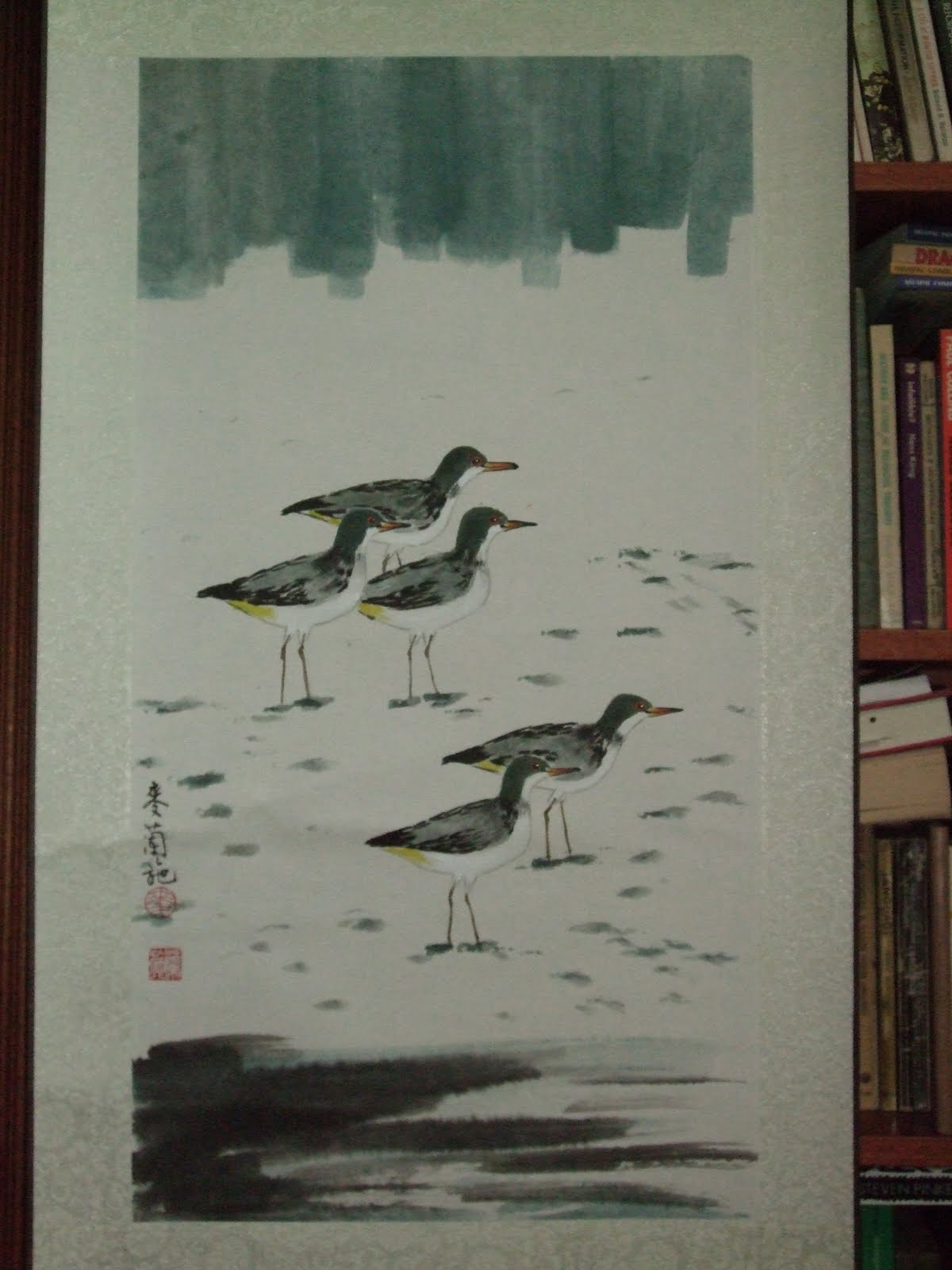
The members of the Australian Lingnan Chinese Art Association held an exhibition in Melbourne between 16th and 22nd May 2011. This was quite a large representation of this style of painting. Each exhibitor was required to contribute three paintings and there were over 100 paintings on display. Subjects of the paintings included animals, birds and landscapes. Many people visited the exhibition and there was a very favourable response to the paintings.

My modest contribution can be seen below.

Bambbo and the Butterfly

Magpies and Willow

Waterbirds

Quote

" All the world's a stage, and most of us are desperately unrehearsed."  Sean O'Casey (Irish playwright)

Saturday, 25 June 2011

An Incident in Moscow

One of the worst things that can happen to anyone when traveling is having your wallet stolen. One of the worst places for this to happen must be Russia.

My wallet was stolen on a crowded subway train. Luckily a young woman who spoke some English saw my consternation at my discovery and came to the rescue. She negotiated with the Subway Police at the next station but we needed to go to their headquarters. This was the start of a long and convoluted sequence of events. We traipsed out of the subway, down a dingy alley, through a turnstile and finally to this rather rundown building that looked abandoned. As the door opened it revealed that it was really a10cm thick steel door tastefully disguised with wood panelling on either side. As we entered the holding cells were to the left and there was one of the police wandering around with an AK47 casually slung over his shoulder.
We (me, my husband & the Russian girl) were then summoned upstairs to the inspector’s office.  Up the rickety stairs, then into the office where a thick smoke haze wafted over us, the television was on, showing a variety show, a girlie calendar decked the wall. The inspector greeted us then went to the wall safe, turned the tumble lock and put away his instant coffee and mug (obviously so precious they don’t trust each other, let alone foreigners, even in the police station).
We explained what had happened. The police were all very friendly and jovial, and were sure they would find the wallet with credit cards but no money. They didn’t feel the need to write the police report on the weight of this rather shaky prediction. They then asked us to return at 5.00pm to check on the results. All this took at least 3 hours and we still hadn’t cancelled the credit cards.
Negotiating the police was the easy bit.

We had checked out of our hotel as we were leaving Moscow for St. Petersburg that night, our bags were still there and we decided to go back to the hotel to use the phone as we thought it would be the easiest option. We had to use the Business Centre and as there is no reverse charges or free call in Russia and we had a rather long call which resulted with us ending up with a $200 dollar phone bill, we were pleased the line was so bad that the call centre had to call back or it could have been more.
We returned to the police station exhausted as all this had taken most of our day. Of course they hadn’t found the wallet and it was only then did they sit down and begin to write the report.

A Quote

"The things that destroy us are: politics without principle; pleasure without conscience; wealth without work; knowledge without character; business without morality; science without humanity; and worship without sacrifice."
                                                                                                       Mahatma Gandhi

Sunday, 19 June 2011

The Year of the Rabbit


My first painting for the year 2011

This is the year of the Rabbit according to the Chinese horoscope.  Each year is attributed to an animal and it runs in a 12 year cycle. Last year was the tiger, next year will be the dragon.
Those born in a Rabbit year are considered to be articulate, talented and ambitious. They are often admired and financially lucky, as well as being even- tempered and wise. Read more about the year of the Rabbit and other animals in the Chinese horoscope at http://www.c-c-c.org/chineseculture/zodiac/Rabbit.html

Thursday, 16 June 2011

Jelynn - A Short Story

  
Barely able to catch my breath after walking up eights flights of stairs, though by the time I reached the fourth it was more like crawling. Sweat pouring off my forehead, red faced and puffing like a steam engine, I’ve lost any sense of dignity or superiority as I staggered into the classroom to face my first class in China.
I’m not very good with names.  I find it hard to remember the names of students in small classes, so faced with 80 Chinese students, with unfamiliar names to learn in just eight weeks, I am filled me with dread.

The boys breeze into the room, and without embarrassment, practice their English, “ Hello, Miss. What your name?”
The bell rings.
‘Hello everyone, I’m your teacher for this semester. My name is Elizabeth, but call me Liz it is easier, I say as I carefully write my name on the board.
“I need to call the roll, please forgive me if I mispronounce your names, correct me and I will try to get it right next time. Also it will help me to know who you all are.” I say breezily.
I look at the roll, “Hell, I’ll never learn all these names, I’m stuffed,” I think.
Just saying, “You” and pointing is not a good look.
 I start calling the roll.  Thank god most of the students have given themselves English names. The ritual calling of the roll is not only compulsory it also helps me fixate some of the names to faces.
There is Webber the tallest and largest in the class, like a gentle bear, always early and sitting in the front row. Next to him is Billow, never without a smile, wanting to please. Then there is Michael cheerful and eager. Rick and Christine like Siamese twins, arrive, leave, or absent, together. Then there is Rock. Never on time, produces no work and seems to be on another planet.

 Somehow the girls all merge together, they all come quietly into the room, smile and sit demurely.  Faces and names don’t seem to connect.  Except one, Jelynn, she is tall, almost statuesque. She dresses elegantly but not expensively. She has a refined beauty, only after closer scrutiny do I notice she is wearing make up. The other students always note her entrance, especially the boys who, like me, are drawn to her quiet beauty.

She doesn’t always arrive on time, often absent, which I note negatively. This doesn’t give me a good impression; negative thoughts are already emerging about this student. Her work is average and she makes very little contribution to the class.  She seems distracted during many activities but is happy to participate in a steady and measured way and the other students want to be part of her group. No one wants Rock in their group, as he is not noted for his enthusiasm or participation.
 ‘Miss he can be in our group’ Jelynn offers happily, murmurs of disapproval and frowns on the faces of the rest of the group show they are not happy about this, but she responds with a smile and ‘It will be OK’ and they accept  this without further rancour.

One day before class Jelynn approaches me earnestly, “What does she want now?”  I sigh, “She has been away for a week and has produced no work. What pathetic excuse is she going to come up with?”
“Miss Beth, I’m sorry I was absent last week, but my grandfather was very sick. I had to go to my grandparents’ home in the country to look after him.” she explains.

There is something about the intense way she looks at me, pleading and doleful, willing me to believe her and understand. A crack slowly begins to appear in my natural sceptism.
“I’m really sorry to hear that. But you know, Jelynn, you have missed a lot of work and you haven’t handed your assignments in yet.” I tell her quite sternly.  

“ Oh yes, I will get it done.”  Jelynn promises.

Weeks go by, Jelynn’s promises of work still haven’t materialised. I am becoming impatient and more irritated with her attitude to her work. She arrives in class chatting quietly and laughing with her friends, she seems in good spirits, confident of her good looks, yet there is an air of vulnerability about her, a sadness in her eyes, which appears when she thinks no one is looking.

“Jelynn you have been away a lot and we are half way through the course, and still you haven’t given me the first major assignment.  Remember you are meant to interview one of your fellow students and write their biography. You need to hand it in by next week, or you will fail,” I tell her emphatically.


“ I will give to you on Monday, Miss Liz”, Jelynn confidently states.

Monday comes, Jelynn is early, and she hands in her work.  Jelynn, who barely writes a paragraph in class now has presented the longest piece of work I have received from any student.
  
I now have to read and correct each students work. I leave Jelynn’s until last. I’ve glanced at it and expect it to be a hard read because her skills are not very good, also it is so long it will require a great deal more time. Having finished correcting all the other students work, I take a deep breath and I start to read Jelynn’s piece.

There was a girl had a beautiful mother. She loved her dearly. A little girl her life  perfect. Then  she grow older she begin to see her parent argue and fighting all  time. Her father go out with other women and her mother left at home night every night lonely sad. They shouting and anger around make her very frighten. She hide in corner with hands over  head and eye closed, wanting them  stop scream at each other.

She start to hate her parents now; they  make her life so unhappy. She run away many times when she little. She beaten and sent away to aunt, but don’t really want her, for many months.

At night, she quietly weep under blankets. She did not obey her parents, didn’t do her school work. She is wild. She want to punish parents for the unhappiness they cause her. She would dressed in short tight skirts, high heeled shoe, her make up be of bright blue eye shadow, ruby red lipstick on her face, smoke and drink and staying out all night like her new friends.  She want  belong, be liked, her new friends didn’t really care about her. They only like her for the money she could bring for their night games . She stole this money from  parents. She was make to stay home, but this didn’t stop her go out the window at night, so she could be with her friends.

When she was fifteen she came to her sense. Her parents had divorce.  Her mother became very sick, the doctor say cancer. She beg her mother to forgive her for all the terrible things she do. She sit on her bed and cry and cry her heart. She understand now how much she love her mother and how much she want her mother be with her. Every free moment she spend with her mother.

As I’m reading the story the poor grammar is overlooked; the poignancy of the story takes over.

Next class I look for Jelynn. I want to tell her what I think of her story. I anxiously await her arrival. Roll taken, Jelynn still hasn’t arrived. Then half way through class I see her try to slip into class unobtrusively, bent over trying to hide behind the other students, trying not to interrupt the class or gain my attention.

As the students are leaving, I call, “Jelynn, before you leave I want to see you”
She looks startled at first, comes up to the desk, a slight frown appears, “Yes. Miss Liz”
“I’ve been reading the biography you have handed in.”
“Yes” she responds.
‘You wrote a lot.” is all I can say, then add “I haven’t finished correcting it yet. I will give it back to you at the end of the week”.

I go back to her story and continue.

When her mother taken to hospital she  go there every afternoon after school and stay  until morning. Her mother grow weaker and weaker and she see that death come soon. Emptiness she feel the day her mother die. She like a robot, she don’t think or feel everything done like robot. Now she alone.

Her father didn’t want her. She then sent to her grandparents, her mother’s parents  live in the country. They very kind to her. She loves them dearly. Her mother had some of money, which be used for her education.

She now is work hard at college to get  good education so she can make her mother proud of her and show thanks to her grandparents for their love and work.

Friday comes and at the end of the class I hand back all students’ work, but leave Jelynn’s until last. 

The bell rings just as I call her name. I’m holding her work, flicking through the pages.
She stands looking worried as I say, ‘Jelynn, you have written your own story, haven’t you?’

I find it hard to know what to say next, but blurt out, ‘If you need any help in any way I would be happy to try and do something’
In a moment of empathy the thought of, ‘I could be committing myself to anything’, flashes through my brain.
‘Thank you, thank you. You are so kind,’ as she takes her work and holds it close to her chest.

We then walk down the stairs together talking about where we are going to have lunch, what we will be doing at the weekend.

Monday comes and the weekly routine starts again. It’s Wednesday I’m rushing downstairs to lunch and I bump into Jelynn on her way up.
She spits out with sheer hatred, “ I’ll never forgive him for what he has done!” 
I’m almost speechless, ‘My God whose done what?” I think.
“What is the matter? I asked, ‘who are you talking about? What’s happened?’

‘My father, I never forgive him.’
‘What’s he done?’
‘He won’t let me stay at his house anymore’
‘Why not?’
‘He’s got another wife and he doesn’t want me there. He says I just have to find somewhere else. He won’t let me go to his house again.
Well you can stay there until you find somewhere else, can’t you?’
‘No, he said I to go now.’
‘He took my mother’s money too, the money for my education and he used it for himself. I’m going to show him. I’m going to do well. I’m going to get a good job. I will never, never go to him again.’
‘Are you sure? He is your father.’
‘Yes. I never forgive him! ‘ Tears start trickling down her cheek. My arm goes around her shoulders.
‘Everything will work out.’ I’m sure your father doesn’t mean he never wants to see you again’

The last week arrives; the main feature of this period is assessment.

Jelynn is present for the written exam; the oral presentation is the next day. Students have to pass all sections of the assessment to pass the course.
Jelynn comes up to me again at the end of class. ‘Miss Liz, I won’t be here tomorrow.”
“Why not Jelynn, you have to complete the oral assessment to pass,” I say anxiously.
“My grandfather is in hospital, and he is dying, there is no one else to help him or look after him. I have to go back to the country”
I’m dismayed, “ Jelynn, I will see what I can do, from the oral work you’ve done in class, I’m sure that can be taken into consideration. Don’t worry.” ”Please Miss Liz, write your address for me, “ she pleads.
“Of course”, I dutifully write my name address in her exercise book. ‘Now please keep in touch.”  I implore.

 ‘Yes, yes I will. I love you, I will never forget you.’ she says, as she turns and leaves the room.
I stand there watching her leave as gracefully and as dignified as when she first walked into class.