Friday, 7 June 2013

Beijing - April 2013

Our plane was late leaving and we landed even later than expected. I was so thankful that I had booked an airport hotel for the first night as it would have been terrible trying to get to our hotel in central Beijing at 11.30 at night. We asked one of the staff at the airport where we needed to go to get to the hotel. We were taken to the hotel shuttle bus and she promptly asked us for money. ‘What for?’ I asked. She kept saying, ‘Give me money.’ The bus driver said I did the right thing not giving her anything. It was her job to help passengers. The bus quickly took us to the hotel and we were so glad to enter our room and sink into our beds, after having a cup of tea of course.
Next morning we leisurely got up had our shower and a very nice breakfast before we headed of into the fray again.
Back at the airport we found the express train into the city and with a couple of changes on the subway trains we arrived at the station close to our hotel. The worst thing about negotiating transport when you arrive somewhere is luggage. Even with a smallish bag it can be difficult when you have to go up and down stairs without an escalator.
We arrived at the subway station close to our hotel, and then we had to negotiate a pedestrian subway. I was reading the map and turning around to my companion and then tripped on the very tiny step leading down to it. Note there are many tiny steps at entrances to subways, be alert. I eventually stood up but had a very sore and swollen knee.
The hotel was about a block away from Tiananmen Square. We checked in then decided to go to the Temple of Heaven. I had been here many years ago but for my friend it was the first time so I was seeing it afresh. It was a Taoist temple and was built from 1406 to 1420. It was renovated in the 18th century under Qianlong Emperor. The circular   building is a stunning sight and is on a marble stone base. There are beautiful carvings of dragons in the marble in the centre of two sets of stairs. The temple is surrounded by pavilions and beautiful gardens home to a variety of birds. Walking through a long pavilion to the temple groups of Chinese were playing cards, talking and knitting. A real meeting place for many.
Temple of Heaven

We spent a number of hours walking around and looking at the points of interest. We left and wandered into a building across the road, which consisted of many floors of merchandise. As always when faced with a monster amount of goods it becomes completely overwhelming. We both bought a pair of leather gloves and a few other odds and ends. We were very tired and hungry. We couldn’t find much of interest to eat there and decided to go back to the hotel and eat. Bad choice.  The food was absolutely terrible. I refused to eat one dish, it was disgusting and I wasn’t going to pay for it. It took a lot of persuading to get to take the cost off the bill. 
The following morning was the day of the art exhibition, the reason for the trip. It was in the afternoon which gave us time to go to the Forbidden City in the morning. As we were relatively early the line for entry wasn’t too long. The Forbidden City is enormous and too big to see in one day, let alone a morning. It is the world’s largest palace complex and is surrounded by a 52 metre moat.  We decided to see a cross section as it is easy to become overwhelmed and then everything just becomes a blur. You couldn’t enter a lot of the buildings just view the room decorated with the various trappings. It is often difficult to see much at times when large numbers of people huddle
Inside the Forbidden City
around the doorway. It also houses numerous rare treasurers and curiosities, like the clock room in which there are numerous old clocks, mainly European many given as gifts from European delegates to the Emperor. The various mechanical displays were fascinating, though quite ugly.

Typical Gargoyle in Forbidden City

It was the imperial palace for 24 emperors. It was forbidden to enter the complex without permission from the Emperor and was a ceremonial and political centre. Nothing has changed as today’s Chinese leaders have their own ‘Forbidden City’ a compound at Zhongnanhai.
Over the years since the founding of the PRC damage and neglect had taken its toll but during the madness of the Cultural Revolution further destruction was prevented by Zhou Enlai when he sent an army battalion to guard it.
Even just seeing a small section of the Forbidden City you get the sense of the size and the former grandeur of the palace.
Then it was off to the art show.


Tuesday, 14 May 2013

Huangshan and Hongcun March 2013

It took a bit of time but we eventually got through to the girls on reception at the hotel in Hangzhou to get us a taxi to the bus station. They were attractive but not the ‘brightest buttons in the box.’ We caught the bus no problems and finally ended up in Huangshan township. I probably didn’t read the information about the location of our hotel properly as it was actually in Tunxi which we had already passed through on our way. A Mr.Hu was summoned by our bus conductor. He spoke English and explained how difficult it was to get the bus etc. etc. but he would get a taxi for us which would cost us ¥150. We felt we had no other real options so took the taxi.
We arrived at our hotel which was right at the beginning of Old Street; the girls in reception were very helpful and spoke some English. Old Street was delightful it had been there since the Song Dynasty and the shops facades exuded the character of that era. It should have really been called ‘Painting or Art’ Street as the majority of shops sold brushes, ink stones and paper. We loved wandering up and down in and out of the laneways looking in the various shops. It was surprising to see a number of Europeans around as they were in very limited numbers in Hangzhou. I guess as there were more westerners around so there were more coffee shops. I bought a map of the mountains which gave us something to work with for our trip.
Old Street Tunxi


As we were here for such a short time the first full day saw us make our way to Huangshan mountains. The most magnificent scenery with misty clouds can be seen at sunrise. Unfortunately we missed this by hours but the mountains and scenery were spectacular anyway. We took the bus to the bus station of Huangshan town then another bus to the entrance to the mountain area. The trip up to the mountain was around hairpin bends and not much tolerance of space on the road and the drop down the side of the mountain quite terrifying. There are so many walks and places to hike in the mountains that you would need several days to do it justice. Our trip was more Huangshan light. Even though it was a Saturday it didn’t seem that extraordinary crowded as many places can be at the weekends or on holidays in China.
Realizing our time was limited we took the cable car from Yungu Temple station to White Goose Ridge station. The ride itself was amazing and could be frightening if you suffered from vertigo as it definitely a very long sheer drop from the cable car.
We walked along the well- marked and maintained paths to White Goose Ridge, Beginning to Believe Peak, with views of Pen Rack Peak and back to the cable car station passed Lianli Pine. While on our walk we were asked a number of times to pose for photos with fellow Chinese walkers. I always bemuses me that they would want to have a photo taken with some unknown European. Robyn said it was my white hair  that stood out, but I didn’t think it was just that.
  Everywhere you looked took your breath away. The sheer mountains pine trees growing in impossible places and angles. Many traditional Chinese landscapes feature this mountain scenery. My camera worked over time, as an amateur painter in the Chinese style; I have painted scenery like the one I was viewing.
A Huangshan Mountain View
‘Stunning, stunning!’ was all I could say about the views no matter which way I looked, and this was only such a small part of the whole.
It was getting late so we caught the cable car back down and looked for something to eat, there was not much on offering so we had what everyone else was eating, two minute noodles. At least they filled an empty stomach. Then we passed the inevitable array of souvenir shops on our way to the bus to take us back to town. The bus took us back to the bus station where buses to Tunxi left on a regular basis. At that moment we realized that Mr. Hu, our’ helper’ from the previous day was a bit of a con man as he had insisted how difficult it was to catch the bus as they weren’t regular etc. etc.
We were glad we left when we did as it was getting late by the time we arrived back at our hotel. While we were here the first two nights we ate at the fabulous restaurant where you can see the chefs cooking and can choose what you want to eat that way. It is located at the end of Old Street on the corner near the square. Look for a large crowded place. It is a rather frantic system as you get a number and paper and pen, go to where the dishes are displayed, they have names and numbers. The numbers help, because you only need to write down the number. Our first experience there we were helped by a young fellow customer who spoke English, so we learnt the system. The next night we felt quite confident negotiating the system by ourselves. The whole thing seems quite disorganized but the guy who is in charge of the numbers is all powerful and keeps things under control. The most important thing however, that the food was delicious.
Robyn was looking up information about the area on the internet and came across a place called Hongcun, 85km from Tunxi. So instead of going back to the mountains we decided to go there the next day. We managed to catch the right bus and a young Chinese student guided us to the entrance when we arrived.
Hongcun was established in the Song Dynasty but many of the buildings date from the Ming and Qing Dynasties and regarded typical of the Anhui style. It is an extremely picturesque village which is crisscrossed by canals which flow into the central moon pond and southern lake. Mainly Chinese tourists visit here and it used to be free but now it costs ¥104 to enter as it’s on the UNESCO World Heritage list, so they want to preserve it.  
We enjoyed walking around looking at the buildings and places of interest. We watched a woman make a varied coloured type of pancake. It was fascinating watching her add the various colours to form swirls. I bought one just to try it. It was rather yummy. Just next door was a coffee shop and we had a coffee plus the pancake.  As usual we wandered around for ages.
The inhabitants get about their daily business without bothering much about the visitors Chinese or otherwise. Though there are some of the usual tacky souvenirs about nobody bothers you to buy them. We eventually found a little place to have lunch and as luck would have it there was someone at the next table who spoke English helped us negotiate the Chinese menu.

View across the lake of Hongcun

Hongcun is not on the westerners tourist map, but many may be familiar with it via the film Crouching Tiger, Hidden Dragon as a number of the scenes in this film featured this town. After spending most of the day here we luckily went to the bus station just in time to catch the bus back to Tunxi. We were keen not to arrive back too late as we were leaving that evening for Beijing. We decided to eat somewhere different to our previous nights as we didn’t want to be waiting around too long for our dinner.
Our plane was leaving at 9.30 p.m. so we didn’t have to rush. After dinner we collected our luggage, grabbed a taxi to the airport.

Thursday, 25 April 2013

Hangzhou March 2013

The railway station in Shanghai was enormous but we found the ticket office in no time, I discovered we were unable to purchase using the automatic ticket machines as you needed a Chinese I.D. card, so had to wait in line at the ticket counter. The line moved quickly and we had to produce our passports to buy our tickets for Hangzhou. Trains leave frequently so we didn’t have much of a wait. To our surprise the train was sleek and modern and turned out to be a fast train travelling at an average speed of 219 kmph so the journey took only 55 minutes.
When we arrived it was raining and as usual there was general confusion around the station with many arrivals and departures milling around. I thought getting a taxi to our hotel would be easy especially as I had the name and address written in Chinese characters, however, no driver wanted to take us. I bought a map hoping the hotel wasn’t far but it was no help. We walked away from the station in hope that we might be able to hail a more co-operative taxi driver. No luck. Some young people came to help us and said, ‘You can’t hail cabs.’ I explained that I had seen many people do so, why not us. After some further discussion they hailed a cab for us and press ganged the driver into taking us to our hotel, which wasn’t that close to the station after all.
We arrived at our hotel the Wuyang Inn which was in the old area and was a delightful small very Chinese Hotel, with minimal English spoken by the reception staff. We settled into our room then went to explore.
Scene around Hangzhou


Hangzhou is a very beautiful city with the famous West Lake. We walked out of our hotel and turned right and walked a very long way and eventually found the lake. We walked along its bank but we felt cold and a little hungry. We then found a really nice place, an Arts ‘Club,’ which had quite a colonial feel to it. We were ushered in even though we weren’t looking too posh in our jeans and parkas. We sank into the armchairs by the window and had coffee and cake at ‘private club’ prices, but the most important thing was we were warm and dry. We had to tear ourselves away and find our way back via an easier route.
Heifang Street is where you can buy a variety of Chinese products, tea and tea sets dominating. We lusted after many of the beautiful Chinese tea sets but commonsense prevailed and we resisted the temptation to buy. We ate some very tasty street food along a side street; we then meandered back to our hotel looking at the variety of shops and stalls on the way. At the gate of the old part of the town a number of women were dancing/exercising to music. They encouraged me to join in which I did, but it was very cold so I stayed for a few numbers then we went back to our room.
The next day we went on a tour, it was for Chinese only but there wasn’t much else offering, we thought it would be OK. The tour guide had a little English but left us mainly to our own devices, but she was a motor mouth, in Chinese her commentaries didn’t stop and she seemed barely to take breath, even the Chinese started tune out.
 We went to some really beautiful places, with poetic names, for example, Tiger Running Spring, Three Ponds Mirroring the Moon and Yellow Dragon Cave. As it is spring everywhere the blossom trees are in flower and are just stunning, especially as you walk around the lake.
Mirror Lake
 We also visited Yufei’s Mausoleum, which is the result of another bloody episode in Chinese history. During the 12th century Yu Fei was the commander when China was attack and even though he was successful in repelling the invaders, he was recalled to the Song court and executed due to treachery. More 
Yufei's Mausoleum
than 20 years later he was exonerated (too bad he was dead) and his corpse was re-buried at this site.
The worst part of the day was visiting Songcheng Silk Factory. It was noisy and it was hard sell on very expensive silk doonas. The exit was through the shop of rather ugly doona covers and clothing and then a supermarket. We escaped quickly as did a number of the Chinese. From there we went to Lingyin Temple which was originally built in 326 AD, due to war and variously calamities it has been restored 16 times, the present buildings are from the Qing dynasty.
While wandering around the public gardens there was a small group, singing and dancing. A rather charming man asked me to dance, he was very graceful and I felt a bit of a bumble foot. After the music stopped I thanked him and he replied in impeccable English. I wondered what job he might have had in the past. Then a granny minding her grandchild asked me to dance with her so I obliged. Then there was some more singing, but by this time we thought we better get back to the bus.
The trip gave us some interesting views of the countryside and we saw many places, both large and small growing tea. It was inevitable then that we would end up at a tea tasting place. We had all the ritual plus showing us the health properties, hoping to sell it to their captive audience.
We returned to the town around dinner time and as we had seen food stalls setting up in our hotel’s street the previous night we decided to eat there as it was so convenient and we had a delicious dinner very cheaply.

Blossoms around the lake

Our first job on our last day was to buy our bus tickets to Huangshan. We discovered that they could be bought ahead of time at the post office which was very convenient. We then contemplated riding a bike around the lake but as the bike path was close to the road from which there was no view of the lake we decided to walk instead. It was such a beautiful day walking around the lake was very relaxing despite many other people doing the same thing. The blossom was out on the trees ranging from light to dark pink, some with both colours. Spring was definitely in the air. We ended up with quite a good view of the dancing fountain which was fascinating.

West Lake Hangzhou

We made our way to the pagoda we had seen in the distance on previous days. It was a modern construction with even escalators up to the entrance and lifts inside. It wasn’t overly interesting but it did provide a good view of the surrounding areas.
That night we did a last circuit of the night market, ate at our favourite stalls and then packed for our next destination.


Shanghai March 2013

We arrived early evening at Shanghai airport and after the usual formalities which were efficiently dealt with we made our way to the metro station which provided us with a direct line to East Nanjing Road station not far from our hotel. It was with amazement that I found the road and hotel without one wrong turn, however by now early evening had become late and we were rather tired.
Our hotel The Manhattan Bund Business Hotel has art deco-ish décor but is not a patch on the Peace Hotel, they are at very different grades. We get to our room in hope of just relaxing but had difficulty with the safe in the room as it was closed and we couldn’t open it, our phone didn’t work and two lights were out. After much too-ing and froing we finally got everything fixed.

Buildings along the Bund

The first full day we started off with the Bund self- guided walking tour which is always very interesting with all the magnificent buildings of the international concessions. They stand out as symbols of the wealth from trade, especially the opium trade during the late 19th century. We had wandered as far as the old British Consulate compound, they certainly did themselves proud. The main building is now used as a financial institution, rather exclusive of course.
We had explored much when a young Chinese couple asked us to take a photo of them together. I obliged with this and then they chatted us up as only the Chinese can do and persuaded us to go with them to some cultural ‘thing’.
‘It’s not far and is not long,’ they said. ‘Blah, blah, blah.’ It is so easy to get caught up in this sort of thing. Any way we duly followed them and we arrived at a small teahouse. At once alarm bells rang in my head as I had read about scams where one is taken to a teahouse and can be left with an exorbitant bill. After much discussion it all seemed above board so we stayed. It all proved very interesting though I had been through a similar tea ceremony before.
We all paid for equal portions of the experience and exchanged the usual email addresses we went our separate ways. We then decided to continue our Bund. Walking tour, so back to where we had met them.
We continued along the Bund and then walked in the opposite direction as we wanted to go to the Yuyuan Garden. We walked in and out of the back streets of the old town and eventually arrived at a garden which was very nice and just before the place where we wished to go. As we were walking around I slipped on a step, no it wasn’t clumsiness but a very slippery surface. No bones broken, but a little shaken we continued on our way. We found the gardens which was a combination of pools and plants as well as old buildings and shops selling Chinese handicrafts. It was all very interesting and being Saturday was very crowded. We went to the Xingtin Teahouse and had some tea and snacks which was delightful.
Xingtin Teahouse
We then strolled back to Nanjing Road, promenaded up then back looking in the various shops. By this time we were getting tired but decided to treat ourselves to a drink at the bar of The Peace Hotel we had some rather overpriced nibbles and enjoyed the art deco surroundings. We then went around the corner to our more humble hotel.
As we sat at breakfast looking out the window we could see this was not going to be a day for a lot of outdoor activity. It was pouring with rain. I thought a trip out to the French Concession might be good. I thought I figured out the correct subway station to go to but nothing gelled. The rain became heavier so I decided on the taxi solution. It’s a good job as we were actually quite a distance from our objective.
The French Concession is an extremely nice area of pedestrian only streets weaving in and out of low rise grey brick buildings with very upmarket shops. Amidst high end consumerism sits the site if the first National Congress of the Communist Party. Since I was here in 2004 they have built a more impressive museum to this event and moved the diorama from the original house to be a centre piece of the museum, with the original house next door.
We then took another taxi to the Shanghai Museum. The museum is very interesting and the galleries include bronze, ceramics, calligraphy and painting. It was good to be able to get an audio guide which gave historical background as well as highlighting pertinent features of some items on display. Of course no museum visit is complete without a visit to their shop which had many items for sale that I could readily have bought, but sanity prevailed as well as the thought of the extra weight of books so I refrained from a buying spree.
By the time we left it was getting late and we hadn’t eaten much so we found a place to eat in a food court and had a large bowl of dumpling and noodle soup.
The following day we took a taxi out to the Jade Buddha Temple which is one of the few active Buddhist temples in Shanghai. It was built in the early 20th century with the centre piece being a 2 metre high white jade Buddha. The seated Buddha is encrusted with gold and jewels and is said to weigh 1000kg. The reclining Buddha also made of white jade is smaller. There is a vegetarian restaurant that sells cheap lunches and there seemed to be just one dish on the menu of which we bought and decided to share.
Reclining Jade Buddha
We needed to get a taxi back to the centre and from there we went down to the bank of the river to see if we could take a short sightseeing cruise downstream. We eventually found the terminal which had certainly changed from when I was there 9 years ago. Many amenities were upgraded for the big international exhibition they had in 2010. We had a pleasant if somewhat cool trip but it was fascinating to see a lot of innovative architecture along the way. That evening which was our last we walked to the building which has hundreds of little
shops selling ‘fake’ merchandise. It was mindboggling. We bought a few things but saw many Westerners with bags and bags of stuff. There happened to be a food court in the complex so as we were tired ate there. Then wandered back to our hotel to pack.


Saturday, 27 October 2012

Oslo - continued


\The Kon-Tiki

We took a ferry across the harbour to the Kon-Tiki Museum. Thor Heyerdal became famous for his epic journey across the Pacific Ocean on Kon-Tiki in 1947.  He believed that South Americans in pre-Columbian times could have colonized Polynesia. Using materials and the technology available in those times he built his boat. The journey was a magnificent feat but anthropologists have now discredited this theory. His excavations on Easter Island consolidated his reputation as a scientist. He followed up his Kon-Tiki voyage with expeditions on reed boats; he tried to re-create possible trading voyages of ancient Egypt and Mesopotamia. The reed boats became water logged and had to be abandoned. The museum has the original Kon-Tiki and Ra 2, it was very exciting to see them as his voyages were very famous for years after their completion. He was a very fascinating person and tested his beliefs in all areas. It is a small museum but it was a very worthwhile visit and engaged us for a couple of hours.

Details about the Fram

We wandered towards the pier to catch the boat back; we passed the Fram Museum and decided to have a look. The Fram was built in 1892 and hailed as the world’s strongest ship. Extensive research had gone into the design so it wouldn’t be crushed by pack ice.  In its time it had sailed furthest north and south than any previous ship. It was used for three polar expeditions; first by Fridtjof Nansen, 1893-6, who researched how the Inuit survived in polar conditions and applied them to his expedition, Otto Sverdrup, 1898-1902 and Roald Amundsen 1910-12, the first man to reach the South Pole. You are able to board the Fram and wander over it the thickness of the hull and its unique shape was fascinating. There was also a temporary display on Scott’s expedition to Antarctica, he seemed grossly under prepared and relied too heavily on mechanical transport which hadn’t properly tested in the extreme cold conditions and was useless. It was a fair representation of Scott’s expedition but you couldn’t fail to see that the Norwegians were streets ahead in their research and understanding of what they were likely to encounter. We learnt a great deal from this visit.

Ibsen Museum

Back to the other side of the harbour again and off to another museum. We’re just about museum junkies but you learn so much from the small specific subject museums. So from adventure to literature, we headed for the Ibsen Museum. The museum is the fully restored apartment of Ibsen and his wife who lived there from 1895 to 1906 and 1914 respectively. Ibsen was rather vain about his appearance and writing; he had a portrait of his literary rival on the wall to inspire or was it to goad him to write better. Everyday Ibsen would walk to the Grand Café in the Grand Hotel, he had been a friend of Edvard Munch but they fell out when Ibsen paid a bill for him as Munch didn’t have the money on him. Munch was offended and never saw Ibsen again. You are given a guided tour of Ibsen’s apartment which is very informative plus they show an interesting film about his life the sessions alternate between Norwegian and English narration.
After this we decided that we had fitted enough into the day but as we wandered back to the centre we passed the Rådhuset (Town Hall) it was still open to visitors so we decided to have a look. The building was commenced in the 1920s but was officially opened in 1950; the delays were due to the Depression and war. It is a stark austere building that dominates the skyline; however the decoration and murals inside have an art-deco feel about them. The artwork depicts Norwegian history, on entering the building the lobby is filled with light and colour; the walls are decorated by a long list of Norwegian artists.  We enjoyed looking at the murals, and the various rooms, one named the Munch Room which displays some of Munch’s art. The carillon on the east tower plays a tune, often seasonally inspired music by Norwegian composers. The streets around the building are lined with restaurants, bars and shops.
After this we felt we had taken in enough for one day and our next big decision was where we would eat.  We tried to find a restaurant we had seen the previous day but it eluded us, we looked in at one with Norwegian cuisine but that didn’t really inspire us so ended up with Indian.

Munch Museum

The next day a short train ride took us to the Edvard Munch Museum. Apart from the National Museum the Munch Museum holds an extensive collection of his paintings. There is a permanent display and rotating displays of his other paintings. Puberty (1894) is a picture of a young girl sitting naked on a bed and expresses the vulnerable phase of the passage from childhood to adulthood which inspired the temporary display. Of course no Munch exhibition would be complete without another version of his painting The Scream which is placed with his paintings Anxiety and Despair.  Other motifs on display are the bewitchment of the dark forest and the allurement of water. It would be interesting to see what other paintings of Munch would be featured in 12 months time.
We went across the road from the museum to explore the Botanical Gardens it was a beautiful sunny day perfect to wander through the trees and flowers. Then we went back to the city centre to the Arkehus Castle and managed to get there before it closed this time. It was originally built as a medieval castle around 1300 to defend the capital. During the first half of 17th century the castle was rebuilt in the Renaissance style and surrounded by a bastion fortress then it fell into disrepair in the 18th and 19th centuries. It has since been restored. You can now wander from room to room which include the dungeon, Royal Mausoleum, Castle Church, and the Hall of Christian IV, Romerike Hall which today functions as a dining hall for official banquets and the Hall of Olav V. Each room has detailed information which makes the visit worthwhile.

The Opera House

The next and our last day we enjoyed morning tea at the elegant Grand Café,  we sat outside as the weather was warm and sunny, plus if you were only having coffee and a cake and not lunch you were discouraged from sitting inside. The Grand Café was the famous haunt of Erik Ibsen. The café is part of the Grand Hotel which is where the Nobel Peace Prize winners stay; it is a very grand establishment. We then went to see the new Opera House which was opened in 2008, it has a white marble exterior sloping into the fjord at Bjørvika, and you can wander around it and onto the sloping roof which gives great views of the city and waterfront. There were people who disregarded signs which clearly stated you could not ride a bicycle, skateboard or rollerblades on the roof and there several people on bikes. Obviously even here there are people who don’t think the rules apply to them. It was unfortunate we just missed the English language tour of the interior of the building and we couldn’t avail ourselves of the next one as we were leaving in the afternoon.
We had lunch did a last minute wander around the shops maybe we might find something worth buying, but alas no. We went back to our hotel to collect our bags and we just had to cross the road to the bus stop for the airport bus. We were now on our way home.
Overall we really liked our trip to Scandinavia; Copenhagen was a great city very compact and easy to get around. We also enjoyed Malmö and Lund and wished we had stayed in the Skåne area for longer to explore other places. Bergen was picturesque and had much to see. The Hurtigruten trip along the coast of Norway, around the fjords was a standout and Oslo was also enjoyable.  We never noticed any beggars or really down and out people in Copenhagen; we saw some in Sweden but noticed more in Oslo. We guessed many could be coming over the border from Russia and central Asia. Another note Denmark is the cheapest of the three countries progressively becoming more expensive with Norway being on top of the list. As a guide a pasta, a glass of house wine and a coffee in an ordinary restaurant costs the equivalent of around $AUS110, whereas in Melbourne it would be between $AUS55-60. That said I’m not quibbling, I know Scandinavia is an expensive destination, you just go with the flow and enjoy.


Sunday, 9 September 2012

Oslo - July 2012


Original Sculpture on Oslo Cathedral

On our first day in Oslo we went to look at the Oslo Cathedral as it was close to where we were staying. The Cathedral was consecrated in 1697. The pulpit was completed in 1699 followed by the altarpiece in 1700. Other interesting features such as the baptismal font, organ facade and the Royal gallery were built in the early 18th century.  The beautiful stained glass windows were created in the 1900’s. In 1930 a silver altar by Arrigo Minerbi was installed at the side. There have been many restorations of the church over the years the last being in 2010. The cathedral is an elegant building with little outside adornment, but there are a few of the original sculptures found placed on the outside walls.
After the short visit to the Cathedral we decided to go to the National Gallery. We knew that would take international and local artists. There are some beautiful landscapes especially from the 1800’s such as Harald Sohlberg’s Winter Night in Rondane. There is a whole room of Munch’s work, which includes The Scream (which was stolen a number of years ago and obviously been recovered) Munch a number of versions of this painting.
There was also an exhibition of Christian Krohg’s works and presented some of the main themes from his most important period as an artist, 1880-90. He saw art as a vehicle to enhance public debate rather than just as decoration in the homes of the upper class. His work Albertine to see the Police Surgeon put a current affair on the art agenda and engage the audience in a social issue. This was a very thought provoking exhibition.
I always find it interesting to discover painters from other countries which don’t always feature in art history books.
We managed to spend number of hours looking at the paintings. I find the smaller galleries like this more satisfying than the really large ones which can be overwhelming.  

Royal Palace

As it wasn’t too late we decided to walk up to the palace which wasn’t very far away from the gallery. They seemed to be having ‘renovations’done at the palace which made the visitors entrance difficult to find.   We had to have a guided tour but had missed the English one but could go on the next one and were told we would be given the tour information in English, which we could read.
The Royal Palace was commissioned by the Swedish King Carl Johan and built between 1825 and 1848. King Hakon VII moved in when he arrived in Norway in 1905 and it still is the official residence of the reigning monarch. On the tour we visited the ballroom, chambers used for the Council of State meetings, the formal reception room known for its frescoes of birds, the banquet hall and a number of other public rooms. The park around the palace is extensive and is open all year. The changing of the guard ceremonies occur throughout the day and are more informal and lack the theatrics we have seen elsewhere.
The next day we decided to take advantage of the tour of the Parliament.   Storting, Norway’s national assembly was constituted at Eidsvoll in 1814 but its roots are far older as far back as King Magnus Lagabøte (the Lawmaker) 1263-80 who had the existing body of law put into writing and in 1274 this compilation of codified law was applied throughout the realm and remained in force until 1660.
In 1807 the Scandinavian countries were swept up in the Napoleonic Wars with the countries taking opposing sides which affected the Union of Denmark and Norway. In 1813 the Danish Crown Prince came to Norway as vice-regent. He refused to accept the Treaty of Kiel which ceded Norway to Sweden. In 1814 he called together influential men in Norway with the purpose of discussing Norway’s future. From this meeting a liberal constitution was formulated.

The Storting Chamber

Like Sweden it is a one chamber parliament and has a system of proportional representation, elected members sit according to the area they represent not in party grouping. The President is proposed then elected by members of Parliament. Committees are formed to discuss issues. Parliamentary behavior is strictly controlled. No calling out, cat calls, clapping or bad language, which seems highly civilized compared with our bear pit.

The building itself was completed in 1866 and the style in an integration of elements derived from Italian and Scandinavian traditions.
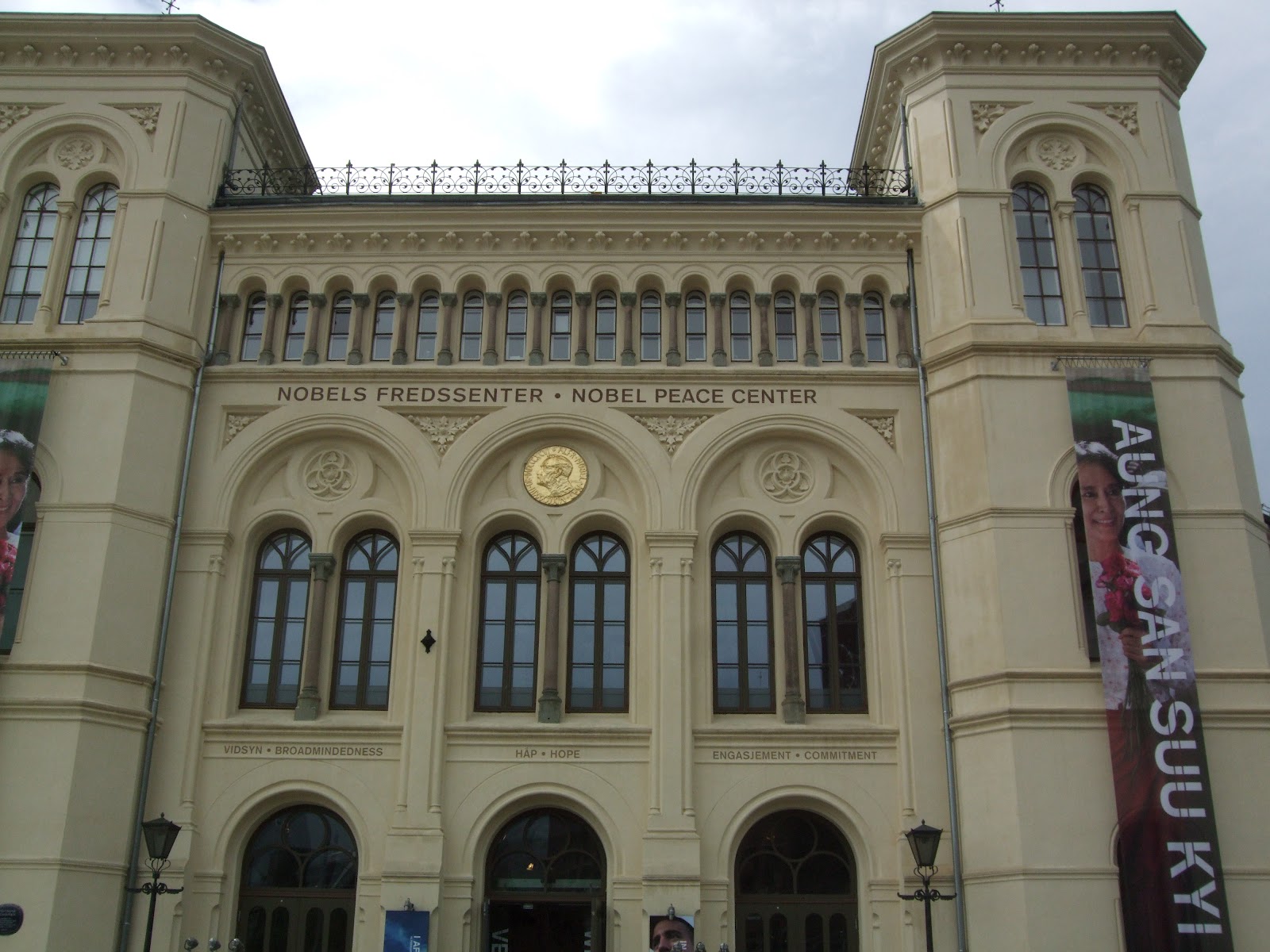
We then went to the Nobel Peace Centre which has information about all the winners of the Nobel Peace Prize. There was also information about Alfred Nobel, was a ‘renaissance’ man with interests and learning in a wide range of fields. He is known mainly for his invention of dynamite from which he made his fortune even though he never actually studied chemistry at university. Though his many other patents were not successful.

The Nobel Peace Centre

The Nobel Peace Centre had two temporary exhibitions one featuring women in Afghanistan, Veiled Rebellion  and the other Infidel  photos by Tim Hethrington on US soldiers Korengal Valley in Afghanistan.
There was also a number of very interesting books in the bookshop.
From a very sobering experience we went off to Arkhus Slot, it was 4.00pm and we thought it would be open until 5, no it was closed. That is one thing very interesting in Norway we found a number of museums and attractions open late and close early. I can understand this in winter, but in summer!

Thursday, 26 July 2012

Hurtigruten- continued


The day after crossing the Arctic Circle marker there was a crossing the line ceremony, a poor relation to that which was performed on passenger ships when they crossed the equator. There was a ‘poor man’s’ Neptune who baptized those prepared to join in with ice cubes and water. The reward for participating was a free glass of Cloudberry wine which was unusual, it being free, as there is nothing free in Norway.
Our last day on the Nordkapp involved two excursions; the first was a bird safari. The weather was windy and freezing as we were taken around islands where large numbers of birds nest during the summer, because of this nobody is allowed on the islands. It was wonderful to see such an array of birds, puffins, gannets, razorbills just to name a few. We even managed to see a few sea eagles circling and some seals popping their heads out of the water. Trying to capture any of this on camera, especially with my little point and shoot was well-nigh impossible, though I did get a couple of shots of a large group of birds on some rocks. I couldn’t include any of them in a CV for the next David Attenborough programme.
Sami mother with baby carrier
It was good to get back to the warmth of the ship after standing outside in the Arctic wind for so long. Late afternoon we had another excursion called the ‘Taste of Lapland’ it was totally set up for tourists but the Sami couple explained about their life and customs of their people.
The area between Tromso and Kirkenes is called Finnmark which is home to 75,000 people and 150,000 reindeers in an area the size of Switzerland. The Sami people are from four different countries, Russia, Finland, Sweden and Norway and up to 700 years ago only Sami people lived in this area. They, like many indigenous people have been discriminated against by forced conformity and forbidding the use of their language, however in Norway there has been a more recent acceptance of their culture and there is a Sami Parliament and their language is taught in schools.
Samis are the only people who are allowed own and farm reindeer. The families who are involved in this move from summer to winter grazing. There are many islands on which the reindeer graze. Reindeers are good swimmers and can go from their summer grounds to winter quite easily on their own but in the reverse situation they are weaker and the Norwegian navy is enlisted to transport them. In the Kjorlfjord area there are 5000 reindeers in summer owned by 9 families.
The Sami now are thoroughly modern and use their traditional dress for celebrations and festivals. Some of them still produce many products from the reindeer and other traditional handicrafts to sell.
Reindeer shedding winter coat
On our excursion we learnt how they made the traditional shoes and reindeer coats for winter and many aspects of their cultural background. All very interesting. We actually got up close to a couple of reindeer which look rather moth eaten as they were shedding their winter coat. An interesting fact about reindeers is that both male and female have antlers  but the female loses hers when she gives birth and then the male grows his, also the antlers  are not symmetrical and each reindeer has its own pattern of antlers, but each year they grow in that same pattern.
We arrived at Kirkenes our last stop and where we left the ship. Kirkenes is close to the border of Russia and very much a frontier town. As we would be flying to Oslo in the evening we decided to take a final Hurtigruten excursion, a bus trip to the border and along the river and taking in scenic lookouts on the way. The signs around the town are in both the Roman and Russian alphabet as many Russians come across the border to buy products to take back to home to sell. I was curious as to what they would buy as Russia couldn’t be more expensive than Norway. It seems that salamis and clothes are the main products of these transactions.  The border control issue was very interesting as Norway as part of the EU signed the treaty for open borders but with Russia there are obvious problems with this with the illegal traffic of arms and nuclear material so both sides control the border. Still I’m sure no border is really impervious to criminals.
Norwegian-Russian Border
We were able to leave our luggage at a hotel after the excursion then went and had some lunch. The choices of places to eat were minimal and so was the menu at the café we went into, a time warp ‘country 60’s’ Australia. It thought it was hip but wasn’t and the girl taking orders destroyed any chance of class by chewing gum. The question is, ‘Was the barrier across the stairs which led to the downstairs toilet to stop children falling down there or customers jumping to their death out of boredom?’
After lunch we decided to explore the town, which by this time left only one museum open, the others being open for just a couple of hours earlier in the day. We found the Borderland Museum without too much trouble, after all the entire town is quite small, so it would take careful planning to get lost.
The Borderland Museum exhibits were mainly about World War 2 and gave a very human understanding of what the people and the town went through during that time. Also there was a permanent exhibition of the Sami artist Savio. He had a hard life as he was orphaned as a young child and was being brought up by his uncle who also died, shortly afterwards. He had recognizable artistic talent and was able to study in this area. He produced some delightful woodcuts featuring Sami life. Tragically he died of tuberculosis at the age of 36. The museum engaged us for quite some time and surprisingly for such a tiny place it had a rather nice shop and some interesting books in English.

Mothers in the war Monument 
 We used the rest of the time to check out the crummy and only souvenir shop and the various monuments in the town and we were done. We then went back to the hotel which was minding our baggage to wait for the airport bus. We were now off to Oslo.